• Home
  • Travel
  • Life Style
    • Category
    • Category
    • Category
  • About
  • Contact
  • Download
Powered by Blogger.

C Travel Adventures

facebook google twitter tumblr instagram linkedin
The first of what I hope to be a variety of trips into the countries surrounding Hong Kong, a group of six of us headed off to Taiwan for a couple of days.  The capital, Taipei, is well connected to Hong Kong with regular flights making the one and a half hour trip across the South China Sea.  Despite being a brief trip, we managed to not only see Taipei, but also got into the countryside to visit the Taroko Gorge, supposedly one of the most impressive gorges in Asia.

Day One: Longshan Temple, Sun Yat Sen Memorial Hall, Taipei 101

Longshan Temple, Taipei
Arriving in the capital around early afternoon at our hostel (Mango 53 Inn), we headed straight over to the the nearest temple, Longshan Temple, which is one of the more impressive holy places within the city.  It was pretty crowded with worshippers when we arrived, but it was still okay for us to look around and get some photos as religion is very much a personal thing over here (it is normal to turn up at a temple by yourself, pray, then leave - as opposed to the set ‘service’ routine of Christianity).  From here we went to the Sun Yat Sen Memorial Hall on the east side of the city.  The MTR in Taipei is very comprehensive in scope (though doesn’t extend to the airport) and is also reasonably priced so is really the only way to get around the city.  Exiting from the station at the memorial we found ourselves in a large crowd of anti-government protesters.  It was difficult to decide quite what they were campaigning against - somebody told us it was something to do with a pay dispute, but there was also a lot of anti-nuclear stuff going on. The memorial itself is dedicated to Sun Yat Sen, known to many as the founder of modern China.  He was one of the leading anti-Imperialist campaigners at the turn of the last century and travelled the world gathering supporters to his cause.  On a personal note, I was interested in him as there is a small plaque in the nearby village of Cottered in the UK, about 10 miles from Ickleford which says that Sun Yat Sen always used to live there when visiting Britain - and I had been intrigued to know a bit more about him.  The memorial is a concert venue amongst other things.

Sun Yat Sen Memorial and Taipei 101

The counterweight
Next to the memorial is Taipei’s newest major monument, the Taipei 101 tower which spent six years as the tallest building in the world.  The structure is meant to look like bamboo and is definitely one of the more elegant modern skyscrapers.  At 509m tall, it is about two thirds of the size of the mighty Burj Khalifa, but is still two thirds taller than London’s Shard.  Considering that Taipei sits in both an earthquake and typhoon zone, the structure is extremely ambitious and uses some novel engineering concepts in order to provide its stability.  Key amongst these is a giant 730 ton iron orb that hangs at the top of the building and acts as a three dimensional pendulum that counters earthquakes and typhoons.  The orb itself is open for public viewing and there are lots of videos on YouTube of it swinging fairly considerably in adverse weather conditions (http://www.youtube.com/watch?v=NYSgd1XSZXc).  Of course, the main attraction of Taipei 101 is the view over the city.  The skyscraper is a bit of an oddity compared to the rest of the city, which is on the whole fairly low rise (especially compared to the vertical living in Hong Kong).  The next tallest building must be a third of the size at most, meaning that the photos look like they were taken from a helicopter rather than the top of a building.  There is an outside area for the public to visit at the very top, which gives the best photos and also gives an indication of the intense forces that the structure has to withstand.  It didn’t seem particularly windy when we entered the building but the roof was extremely blustery.

View from the top of Taipei 101
It was now getting fairly late so we ambled towards the MTR station and from there went over to the Shillin district of the city which is famous for its night markets.  Unfortunately it had started to rain, meaning that we perhaps didn’t get the full effect of the markets, but from what we saw it was a great place to buy clothes and street food.  'Made in Taiwan’ is obviously a fairly common site back in Europe, so as you might expect the clothes were very good value - it would be a good place to get a totally new wardrobe on the cheap.  After eating food at a slightly strange but very tasty steak place, we made our way back to the hostel via a milkshake shop.

Day Two: Chiang Kai-Shek Memorial, 228 Peace Park, Guandu Temple

Chiang Kai-Shek Memorial
Our second day in Taipei (having spent a day in Taroko in the middle) started at the Chiang Kai-Shek memorial which, along with Taipei 101, is probably the leading tourist attraction in the city.  Chiang Kai-Shek was the president of Taiwan until his death in 1975 and is a key figure in the modern history of the whole of China.  He was leader of the Chinese Nationalist Party (Kuomintang) during the civil war on the mainland against Chairman Mao’s Communist Party.  After losing the civil war, Kai-Shek fled to the island of Taiwan (which was then a relative backwater) and declared it to be the rightful heirs to the mainland.  He was followed by many businessmen and others who were set to lose out to the communists.  Having essentially imposed a new government on the island and turning it from an island to a nation, there were obviously frictions with the locals so depending on who you talk to, Kai-Shek was a tyrant or a hero.  Many know him by the name 'General Cash My Cheque’ - referring to his alleged corruption.  Hero or not, he is definitely an important figure in Taiwanese history and his memorial is enormous.  His statue is still guarded by two armed soldiers and visitors are told to assume an adequately sombre attitude.  In addition to the memorial itself, the park contains the National Theatre and National Concert Hall as well as a museum about Chiang Kai-Shek containing uniforms, medals and other bits and pieces from his life.

National Theatre

228 Peace Park Memorial
The memorial is in the centre of the city and is surrounded by a few other sites that we were able to walk past, including the Presidential Palace and the 228 Peace Park.  The peace park is a memorial garden to the people who died during a major government crackdown on protesters in 1947 - on the 28th February (hence the name).  It is estimated that between 10,000 and 30,000 people died and the massacre was the start of a long period of martial law known as the 'white terror’ in Taiwan.  The park has been really nicely done and there is a museum that we unfortunately didn’t have time to enter.  Our last stop of the day was a fair journey to the north of the town and was a great example of the virtues of listening to Lonely Planet.  Based entirely on the book’s recommendation we travelled 16 MTR stops north to a suburb of Taipei called Guandu.  The suburb is situated on the banks of the river and is home to a really special temple that looks back over the water towards the city.  It was a little tricky to find - a 15 minute walk from the station, but was really worth it when we got there and I have to say it is one of the best temples that I have come across in Asia.  The detailing on some of the wood and stone was really astounding (see below).  After grabbing a coffee and some cake we made our way back to the airport for the late flight back to Hong Kong.  All in all a really excellent few days - with a bit of luck I will get another opportunity to visit Taiwan next semester.
Guandu Temple
Woodwork at the temple

Share
Tweet
Pin
Share
No comments
Suzhou canal
Deciding upon having four days in Shanghai was a deliberate overestimate of how long we thought we needed, allowing us to explore at a leisurely pace whilst also heading out into the surrounding area.  The possibility of using the super-fast Chinese bullet train opened up a range of potential day trip locations, including Nanjing, Hangzhou and Suzhou.  We decided upon the latter of these as it was the closest of the three - and therefore the least likely to be visited on a future trip to China.  Suzhou is one the (many - there is even a wikipedia page listing them all) locations known as the ‘Venice of the East’ - a comparison formed around its canal-based transport system, rather than its hoards of tourists and overpriced pizza.  Romanized as 'Soochow’, the city is one of the most important on the Chinese Eastern seaboard with a history stretching back over 2,500 years - making it more dominant than Shanghai for all but the most recent times.  It is about 100km inland from Shanghai - a journey that takes a remarkable 25 minutes (costing £8 for a return ticket).

The Humble Administrator’s Garden
The city itself is an important economic hub and is one of the wealthiest in the whole country.  Expecting to arrive at a provincial-feeling train station, we found ourselves in a brand new, vast structure that was not too dissimilar in scale and appearance to London Stansted airport.  It was at this stage that the massive development of China really hit home as the whole journey had taken place on an infrastructure system far in advance of anything I had experienced back home, or in Europe come to that.  The station sits opposite the northern gate to the old town and we were therefore able to walk to the main area of tourist sights, centered around the best preserved of the old canals.  The city has achieved UNESCO World Heritage status for its preserved canals and gardens and is apparently swamped with tourists in peak season.  Luckily, walking around on a Monday in off peak season was a very laid back experience.  Our first sight was supposedly the most impressive of the gardens of Suzhou, the “Humble Administrator’s Garden”.  Gardens in Asia are very different to their European counterparts.  What they lack in colours and varieties of plants, they make up with placement of trees, water, rocks and structures and result in a general feel that is far less contrived than the regimented paths, fountains and beds of the English country garden.

A side canal
Master of Nets Garden
After aimlessly wandering around the gardens we grabbed some lunch at a pleasant canal-side street stall.  The food was not too dissimilar to the dim sum that we are used to from Hong Kong - a mixture of dumplings and fish dishes that was cheap and genuine seeming.  While the old town contained a range of gardens and temples we felt that its main charm was in the intricate network of canals themselves and we therefore spent the rest of the afternoon ducking in and out of pleasant galleries and shops before coming to the other famous garden - the “Masters of the Nets Garden”.  This wasn’t too dissimilar to the first one but was still worth a visit.  By now we had almost done a total cross-section of the old town, from the north canal to the south canal.  The sky had been grey for most of the day which (perhaps in my overly-optimistic opinion) seemed to be the best way to explore the tranquil gardens and canals.  Unfortunately towards the tail end of the day it started to rain and, having originally planned to stay for dinner, we decided to grab a taxi back to the station and head back to Shanghai.  Anybody with a spare day in Shanghai would definitely enjoy a visit to Suzhou - a place more for quiet wandering and exploring than for rapid sightseeing, particularly if you manage to beat the crowds.
The southern canal


Share
Tweet
Pin
Share
No comments
Luijazui Skyline
As the economic capital of a rising China, Shanghai was in many ways a natural place to start my mainland adventures.  Connected to Hong Kong by regular two-hour long flights and with the procurement of Chinese visas being a lot easier than I had imagined, the four day Shanghai trip took place right at the start of the Spring semester

Day One: The Bund, People’s Park and Luijazui

The Bund
We landed in Shanghai late on Friday evening and did little more than find the hostel (Blue Mountain Bund - well recommended), drink some beer and go to bed.  The next morning we got up as early as we could manage and headed east to the ‘Bund’, the traditional centre of Shanghai.  First, a (very brief) history.  The history of Shanghai has always been intrinsically linked with the west.  After the isolationist China was forcibly opened by the European powers during the Opium Wars, a series of 'treaty ports’ were imposed on China.  These ports were to be opened to western trade and became important international trade hubs, with European merchants taking over swathes of the cities as their own.  The Bund, a road beside the Haungpu River, was the centre of Shanghai’s trade and over time was adorned with grand headquarters of the western companies that settled there - as well as a range of hotels and other entertainment buildings.  Some of the big names that can be found on the Bund include HSBC bank (the Hongkong Shanghai Banking Corporation for anybody who had never heard what it stands for) and Jardines (the opium house that later went 'legit’ and is now one of the largest companies in Hong Kong) as well as a range of luxury hotels.

Nanjing Road
While the city was very busy, the provision for pedestrians was good enough for us to feel we could get around on foot.  Having experienced relatively late growth, Shanghai is based around a grid of roads running north-south and east-west which is good for navigation.  Heading west from the Bund and the river we walked down Nanjing Road, the main shopping street in the city, with a range of European, American and Asian brands.  We didn’t linger too long here however as at the western end of the Nanjing Road was our second sight of the day, People’s Square.  Surrounded on all sides by skyscrapers, this square is a bit of a green haven, containing a range of important museums as well as restaurants, cafes and pleasant areas for afternoon strolls.  It was here that we were introduced to a taste of Chinese romance at the (horrifically named) “Shanghai Marriage Market”.  Here, parents of local singles try to find their sons and daughters suitable partners by reading through thousands of 'advertisements’ that are posted throughout the park stating information ranging from height and age to job status, income and education.  Even Chinese zodiac sign is deemed important - I read that it has been called “a cross between match.com and a farmers’ market”.  Romance, it would appear, is well and truly dead in Shanghai.  We grabbed a coffee at a Costa shop and headed south towards the “French Concession” district of the city.
People’s Park
Mahjong Players in the French Concession
The “French Concession” is a name that doesn’t actually appear on Chinese maps of Shanghai, but is the colloquial term for a group of districts that were once administered by the French while the western powers were carving up the treaty ports.  The area is now full of low-rise shops, cafes and parks and is one of the more popular districts for expats and businessmen to hang around in.  Unfortunately, it was slightly confusing as to where the district began so we only passed through briefly to grab some food at a very local looking noodle restaurant where the menu was entirely in Chinese - leading us to (rather successfully as it turned out) point and hope.  From here we decided to sample the underground network for the first time, travelling very easily back towards the Bund and then on to Luijazui - the new financial centre.
Sunset over Luijazui
Our original plan had been to climb to the top of the Oriental Pearl Tower - the slightly strange looking observation tower shown to the right of the photo.  Upon arrival however we found that there was a two hour long queue, which seemed like a crazy amount of time to wait to climb one tower, considering the shear volume of other tall buildings nearby.  Sure enough, after grabbing a drink at a slightly bizarre tea shop at the very foot of the Pearl Tower, we found that there was almost no queue at the Shanghai World Finance Centre, currently the tallest building in the city (though soon to be replaced by the Shanghai Tower) and also home to the highest observation deck in the world.  The structure, while almost certainly designed to fit in with the Chinese principles of Feng Shui, unfortunately looks just like a giant bottle opener - check out the picture at the top of the blog to spot it for yourself.  The views from the top were, however, unbeatable and we thought they were probably even better than from the Oriental Pearl.  After getting back down to ground level again we grabbed some food from a Chinese restaurant in a mall near our hostel and then made our way back to the French Concession to watch England play Ireland in the Six Nations (as our group was split between between English, Irish and Americans, it seemed a perfect way to spend the evening).  We had planned to get the MTR, but (crazily considering it is one of the biggest and busiest cities in the world) it turned out the last train was before 11am.  We then tried to power walk over but this proved to be too much effort and we ended up grabbing one of the numerous (and cheap) taxis - arriving at a pub just in time for kick off.

View from the World Financial Centre - The Bund is on the opposite side of the river.

Day Two: The Old Town, French Concession and Huangpu River Cruise

Shanghai Old Town
Rising reasonably early considering our late night watching rugby, we grabbed breakfast in the hostel and got the underground to the old town of Shanghai.  I was slightly sceptical when we arrived in the old town as it all appeared a bit too pristine - beautiful Chinese architecture that was so well maintained that it looked like it had only just been built.  I guess it isn’t really a bad thing if the authorities keep the place looking smart though.  The pedestrianised shopping districts were very much geared to the visiting tourists with cafes (including Starbucks) vying with souvenir shops and dumpling restaurants.  In amongst this were some picturesque temples and gardens, the highlight of which was the Yu Yuan Garden, a sprawl of pagodas, bridges, rivers and rockeries that made a nice break from the heaving crowds outside its walls.  You are never too far from seeing the modern Shanghai however and even several miles from the skyscraper district it is possible to see the new Shanghai Tower looming in the distance.

Yu Yuan Gardens
View from the river cruise
After spending the majority of the morning in the old town and grabbing some food and souvenirs we made a brief visit back to the French Concession to spend a little bit more time wandering around its warren of streets and cafes.  We had now got a pretty good idea of our bearings and had purchased a travelcard for unlimited use of the underground for the day (for £1.80) and were quite happy to flit around from one part of the city to another with no particular logical plan.  Our next stop was back on the other side of the river, at one of the city’s many big markets where it is possible to get cheap knockoffs of anything from bags to watches to sunglasses.  The market also contained lots of locals making souvenirs, the most interesting of whom was a man who was painting the inside of bottles using a paint brush with a right angled tip.  Having never seen anything quite like this it seemed like a suitable momento.  By now it was starting to get dark so we made our way back to the Bund where we were planning to go on a river cruise which had been well recommended to us.  It was reasonably cheap and a great way to see the skyline - especially as we had apparently been very lucky with how clear and pollution-free the sky was for our visit.  For the third time in two days we then made our way back to the French Concession to the Tianzifang district where we had some dinner at a Japanese restaurant and stopped by a shisha bar.

Tianzifang, French Concession

Day Three: Urban Planning Museum and Shanghai Museum

The model of the city
Having spent two days exploring the main sights in the city and getting out to Suzhou for a further day, we felt that we had done a pretty good job of seeing the best the area had to offer.  We woke on our final morning to find that it was pouring with rain and therefore headed for two of the museums in People’s Square.  The first of these, the Urban Planning Museum, is a great example of China’s new confidence - it is dedicated to the future vision of Shanghai, centered around a giant model of what the city will look like.  It was very well laid out and included exhibits on everything from the city’s history to how the new airport and dock expansions are intended to look.  Across the road from here was Shanghai Museum, a more traditional museum dedicated to Chinese history.  It is said that China lost a lot of its major artefacts to Taiwan at the end of the civil war and the museums of the mainland are therefore not as good as a country with a history as rich as China’s should be.  It is also said however that of all of the mainland museums, Shanghai’s is the best and it was a good place to spend a few rainy hours.  With that, our time in the city was complete and we made our way back to the airport.  This involved one last show of Chinese prowess, as the airport express is the only operational 'Maglev’ train in the world at the moment.  Short for “Magnetic Levitation” train, the train works by using super-strong magnets to prevent the train actually touching the tracks (and therefore preventing any friction).  The journey to the airport takes less than 10 minutes and reaches a phenomenal speed of nearly 270mph - making the trundling Heathrow Express pale in comparison.  The train demonstrated quite clearly just how profound China’s development has been and how it is such a fascinating place to visit, both now and in the future.  I have a twin entry visa, so I will be back.

Share
Tweet
Pin
Share
No comments

Day One: Old Goa

And so, just over three weeks since we touched down in Mumbai, we were in our final destination of the trip.  Goa was to be a bit different – a place that is legendary for its beaches and hedonistic lifestyle that is unique within India.  Controlled by Portugal for nearly half a millennium (until it was seized back with force by the Indian Army in 1961), it is no wonder that Goa has a culture all of its own – I am sure that if Hertfordshire had been run by the Indian government for five hundred years you would probably notice the difference as you crossed from Bedfordshire, even fifty years after it had been handed back…


Se Cathedral
The plan with ending in Goa was to relax a bit before we made our way back to Hong Kong for the new term.  As a result, we decided to do the bulk of the genuine cultural sightseeing on our first day.  This was centered around a visit to Old Goa, about 10km to the east of Panaji (sometimes referred to as new Goa).  Old Goa was once one of the most important cities in the world – they say that in the days of the Portuguese trading empire, Old Goa was more impressive than even Lisbon.  It certainly would have surpassed the majority of European cities of the same time in both wealth and size.  It was, however, slowly abandoned due to outbreaks of disease and the capital of Portuguese Goa was moved to Panaji. What remains is very strange – the churches and major buildings of what was clearly once a major city, surrounded by a few souvenir stalls, restaurants and houses.  To give you an indication of the faded glory of the place, the “Se” Cathedral in Old Goa is the largest church in all of Asia and contains the biggest bell in all of Asia.  It is surrounded on two sides by forest.

Church of St Francis of Assisi
We spent the whole day wandering around Old Goa, looking in beautiful churches and museums with what seemed to be very few other people – considering just how unique the place is.  UNESCO declared the area a world heritage site and this has gone a long way to preserving many of the buildings which are starting to crumble – the combined capacity of all of the churches in Old Goa is now far, far too much for the local Christian populace and many of the beautiful churches stand empty.  There was something very melancholy about the place.  While I am not a particularly religious guy, I walked around picturing my own little village church and imagining how sad it would be to see it with all the pews and soft furnishings stripped out – Christians who know the bible will know that a church refers to its people, not the building, and bearing that in mind, Old Goa was a town full of ghosts.


Disused Church of Our Lady of the Rosary
The more I thought about it however, the more I realised what a difficult situation the local authorities have been put in with Old Goa.  This was a city that was imposed on India by a foreign power – a power whose inquisition is well documented as killing many innocent people in the region.  The sheer volume of churches at the site are now surplus to the requirements of the (still sizeable) Christian community in Goa and the congregations themselves therefore cannot be expected to maintain all of the buildings.  From a historians point of view, I would say that it is essential to preserve all history as best as possible and welcome the money spent on preserving the area.  However (and I acknowledge this as a crude, simplistic and rather unfair argument) I wonder whether in a hypothetical scenario where the Nazis defeated Britain in WW2, we would be keen on preserving the monuments to their conquest once they had left.  As I say, an ethical dilemma.

Ruined Monastery of St Augustine
Basilica of Bom Jesus
As we made our way up to the hill above the town we reached the Monastery of St Augustine – a church that actually crumbled under Portuguese rule.  Once a large ‘Augustinian’ monastery (I’m not even going to pretend that I know what that actually means), it was abandoned in 1835 and suffered a major structural failure in 1942.  The ruins of the monastery remain, along with the haunting tower which has almost split in half.  Our last church of the visit was the Basilica of Bom Jesus (we saw a fair few others but I don’t believe it is worth listing them all – when you go to Old Goa you won’t miss any).  This Basilica is one of the Old Goan churches that is still in use and actually contains the shrivelled remains of St Francis, Goa’s patron saint.  His body is displayed on an elevated altar in a glass coffin – pretty grizzly really… After what had been a very interesting day, we made our way  back to our hotel for a swim and then headed off for good Goan seafood curry in Panaji.


Day Two: Vagator Beach and Chalora Fort

Vagator Beach with the fort to the left
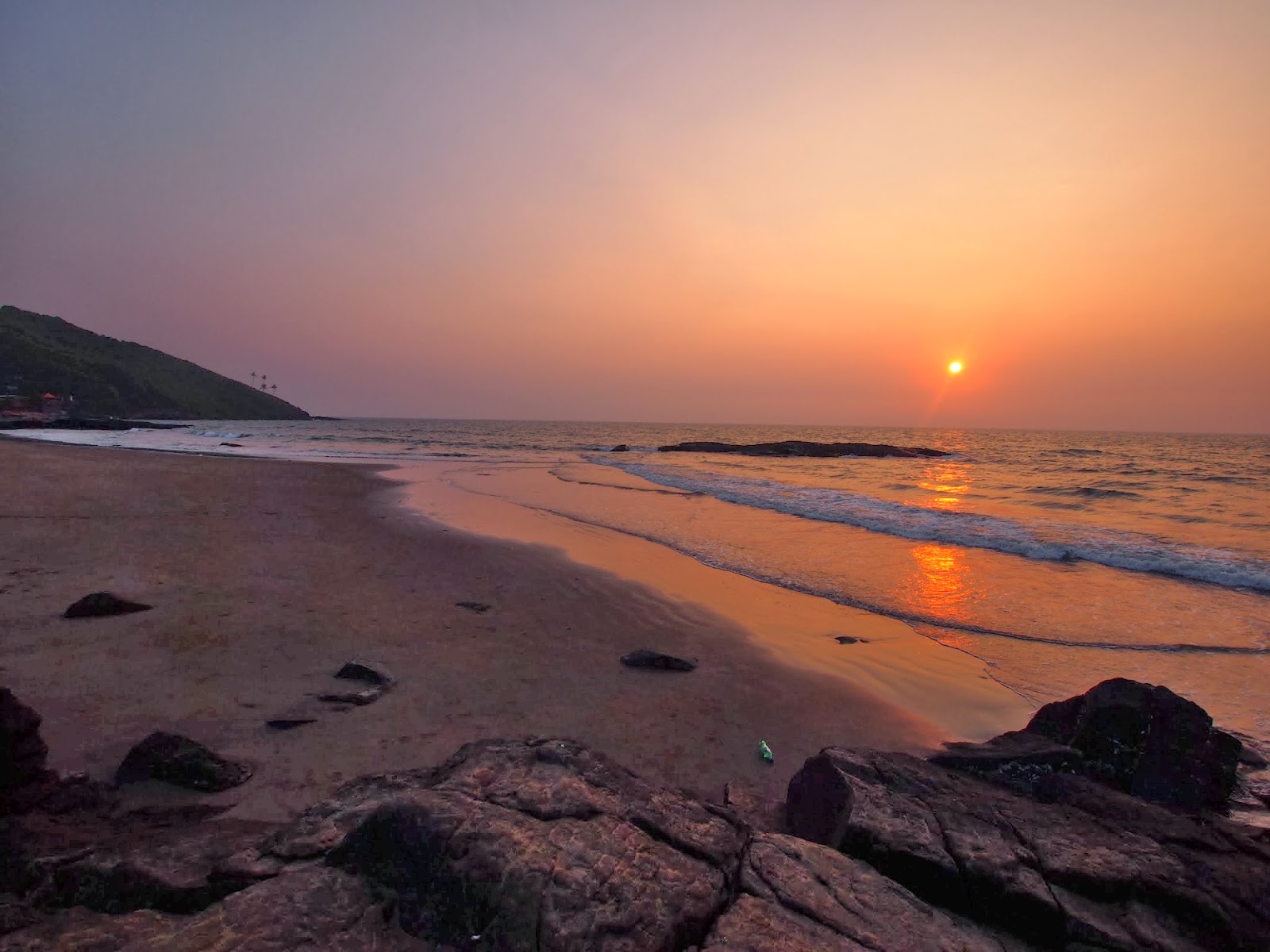
With our cultural day occurring yesterday, myself and Sergei felt able to explore some of Goa’s famous beaches.  Keen to not just go to some ‘Indian Benidorm’ however, we scoured the Lonely Planet for beaches that seemed to have a little bit more to them – almost the entire Arabian Sea coast of Goa is made of beaches so there was plenty to choose from.  We found what we were looking for in a small town located about 45 minutes north, where a beach was said to sit in the shadow of a dramatic fortress, called Chalora.  Arriving at around midday, we weren’t disappointed – while the fort was in a fairly advanced state of disrepair, it offered wonderful views over the beach and coastline.  Once we had got our pictures (and our fill of hot midday sun) we went into the ‘town’ of Vagator – I use inverted commas because the town appeared to be a sparsely distributed selection of restaurants, shops and holiday homes spread through a forest of palm trees.  We ate our lunch at an amazing Greek restaurant with views over the sea and then stayed on the beach until sunset – a very unbloggable activity I’m afraid, but it has been a very busy trip…

Vagator Beach

Day Three: Fort Agauda, Candolim and Sinquerim Beach

Fort Agauda
Today was the last full day of the trip and we were keen to recreate the success of yesterday.  Another flick through the Lonely Planet during our long and excellent breakfast at the Crown Hotel pointed us towards a town just north of Panaji called Candolim which, again, had a great fort and a great beach.  The beach was supposedly the domain of slow roasting Brits and Russians (the two main tourist nationalities in Goa), but we figured we could deal with that if the beach was big and nice enough.  The fort was more impressive than Chalora and the big lighthouse next door was open to the public – and allowed great views back towards Panaji to the south and Sinquerim Beach to the north.  We spotted a nice coastal path from the top of the lighthouse to the beach and this took us about an hour to amble along – the severe cliffs made a change to the long beaches that we had seen so far and actually, in a funny sort of way, reminded me of some of the coastlines of the south of England.  One of the ‘sights’ that I had read about at the beach was a large oil tanker that had run aground about a decade ago just off the coast and hadn’t been removed (at least at the time of writing for Lonely Planet) – however it appeared that this boat had just been dealt with as there were lots of little tug boats off the coast, but no big tanker.  The town of Candolim sits behind Sinquerim beach and was where we had our lunch before another afternoon spent sitting on deckchairs and swimming in the sea.  A hard life for this blogger, for sure.

Cliffs around Fort Agauda
Sinquerim Beach
Sinquerim Beach
Sunset over Sinquerim Beach

Share
Tweet
Pin
Share
No comments
A Goa restaurant (just like Portugal?)
Another day dedicated almost entirely to travel as we flew from Kochi to Goa, via Bangalore.  We had to leave our hotel at the ungodly hour of 4.30am to get to the airport for our first flight, which left at 7.30am.  After the farce of our Mumbai connection earlier in the trip, when given the choice of a 50 minute connection or a 5 hour wait for our connection we decided to err on the conservative side and therefore had a lot of time to kill in Bangalore airport.  Luckily this was one of the more interesting Indian airports that we had visited and I was able to plug my phone in and happily watch more Game of Thrones.  Both of the flights were right on time and we arrived in Goa at about 2.30 in the afternoon.  We would be staying in Panjim, the main city in the state of Goa – while we could have stayed at one of the beaches, I planned to make the most of the city’s central location to explore a bit more of the region.  After recovering from the journey a little we grabbed some dinner (Goa has a famous fusion of Indian and Portuguese sea food), then had an early night.

Share
Tweet
Pin
Share
No comments
Chinese Fishing Nets

Our hotel outside Munnar
I got up early to watch the sun rise, and as it rose was able to fully appreciate what a beautiful location our hotel was in.  With its back to the mountains, our little lodge looked out south across undulating hills of tea plantations.  Unfortunately, our packed itinerary prevented us from lingering and after a quick breakfast we left at 8.30 (relatively late by the standards of the last few days), our driver took us back west to Kochi on the Arabian Sea coast.  The journey was not particularly pleasant – the air condition strained to counter the temperature that rose sharply as we left the mountains and as we approached the city we found ourselves in a reasonably solid gridlock.  We arrived at our hotel, the ‘Pepper Route’ in the mid-afternoon and after some lunch set about exploring Kochi. 

Jew Town - with the synagogue in the distance
Our driver of the last day had offered to stay on with us – ferrying us around the city for the rest of the day and taking us to the airport early the following morning, and with time tight we decided it made some sense.  Unfortunately, hiring a taxi driver outside of his native town turned out to not be such a great plan and we spent a slightly irritating amount of time asking for directions and making wrong turns.  The city itself was very pleasant.  Depending on who you speak to, the city is known as Cochin or Cochi (with a C or a K) and is located on a handful of spits, divided by a network of rivers.  We started our tour by heading for the so-called ‘Jew Town’ – a rather abrupt sounding term for the Jewish Quarter.  The city came to prominence as a major trading centre, ruled firstly by the Portuguese, then the Dutch and then inevitably by the British - with its golden age occurring under the first two of these.  Our first stop was the so-called ‘Dutch Palace’, which was originally built by the Portuguese but was renovated so completely by the Dutch that they got their name attached to it.  Not much to look at from the outside, the interior is extremely grand and is now a museum displaying various artefacts from Kochi’s history.


St Francis Church
Jew Town itself was full of small shops selling everything from standard tourist fare (scarfs and fridge magnets) through to stuff for the more hardcore home decorators - such as giant statues of lions and elephants.  Myself and Sergei settled for a range of traditional Indian trousers, what with our relatively limited carrying capacity.  Aside from the Dutch Palace and the shops, the main attraction of the area was the synagogue, but unfortunately this was shut for the day - the interior is supposedly very beautiful.  Our driver next took us back towards our hotel and the coast of Kochi where we visited the St Francis Church.  This church is the oldest European church in India, having been built in 1503 and was the resting place of the famous Portuguese explorer Vasco de Gama (who died in Kochi) for 14 years before his body was moved to Lisbon - his memorial stone remains inside.  We set goodbye to our driver at this stage (until the morning) and explored the rest of the town on foot - heading to the coast to see the famous Chinese fishing nets.  These nets are a bit of a throwback to a bygone era as modern methods of fishing have made these grand (and fixed) structures outdated and cumbersome - however they remain as a tourist draw.  After watching the sun set over the Arabian Sea (once again) while sitting on Kochi’s unfortunately litter-strewn beach, we made our way to one of a wide range of nice looking restaurants.  While we would be spending less than a full day in Kochi, I was really impressed by what I saw and liked the calm and touristy vibe.  As the gateway to anybody wanting to fly to India to see Kerala, I would really recommend a few days in the city centre itself.

Share
Tweet
Pin
Share
No comments
Tea pickers outside Munnar
Entering the Western Ghats - the mountains
Our driver arrived to collect us from Motty’s wonderful homestay at 6.30am and we set out on our four hour journey inland to the hill station of Munnar.  The hill stations are a series of towns located at a high enough altitude to be significantly cooler than their equivalents on the plains and were therefore often used by the British to escape the heat.  They are also excellent places to grow tea and other plants and crops, so as the scenery became more mountainous it also became far greener.  By the time we arrived on the outskirts of Munnar we were surrounded by beautiful tea plantations and stopped off at a local garden where they grew and sold spices.  I think it was the first time that I was ever able to see the actual plants of some of the spices, fruits and herbs that we are so used to in the supermarkets back at home – I am sure that many people think that pineapples grow on trees, where they are actually very odd looking ground-based fruit.  Other interesting plants ranged from vanilla to papyrus.  We also stuck our head in a garden that was nearby, though this was slightly less impressive – just imagine all the stuff that you would have to see in greenhouses in the UK, but growing outside.


A baby pineapple

Madupetty Dam
Next on our whistle-stop tour of Munnar was the Madupetty Dam, a large hydroelectric dam with a reservoir behind that is a popular spot for locals to come for boating and pony rides.  By this stage the landscape was totally unlike anywhere else we had been in India – more like the Lake District than the dry and dusty plains that we had become accustomed to, outside Kerala at least.  We spent some time at the lake wandering around, visiting the so-called ‘Echo Point’ from where loud noises will reverberate all around the hills as echoes.  After grabbing a bite to eat we made our way to the Munnar tea museum – little did I know when I signed up to year abroad that I would be visiting not one but TWO tea museums, having already been inside the one in Hong Kong.  What more could an Englishman want… Where the Hong Kong museum mainly focussed on the properties of different tea and the ceremonies associated with drinking it, the Munnar tea museum was more geared towards the manufacturing of tea and was very interesting.  I found out a few real gems of knowledge – for example, tea plants (or trees as they actually are) can live and be farmed for hundreds of years and the plants at Munnar, which were planted by the British, have not been replanted (in China they still use plants that are over four hundred years old).  

Kathakali performance
Our last stop for the day was to be one of the more unique aspects of our trip - a ‘Kathakali’ performance.  These dramas, originating in Kerala, contain dancing and music but no speaking - the script is entirely delivered through movements and facial expressions.  We were to see an hour-long show, which was split into a thirty minute demonstration and then a thirty minute performace.  We were walked through some of the common expressions used in the dramas and what they mean, which proved to be very useful when the actual performance began.  Luckily, the guy running the group gave us uninitiated members of the audience a walkthrough of the storyline before it started - making it far easier to grasp what was supposed to be going on.  The show was very impressive - it is interesting to see how absorbed you can get by the movements of an actor’s extremely malleable face…  Given more time in India I would have liked to have seen a broader (and higher budget) version, but the little drama group that we visited in Munnar was an excellent introduction to a dramatic style that I had never previously come across.  It was getting dark as we left the theatre and unfortunately, due to its isolated position, that tends to signify the end of sightseeing in Munnar and we therefore made our way to our hotel, an isolated complex of cabins, for the night where we had our dinner.

Share
Tweet
Pin
Share
No comments
Newer Posts
Older Posts

Search This Blog

About me

About Me


Aenean sollicitudin, lorem quis bibendum auctor, nisi elit consequat ipsum, nec sagittis sem nibh id elit. Duis sed odio sit amet nibh vulputate.

recent posts

Follow Us

Blog Archive

  • ▼  2017 (7)
    • ▼  October (7)
      • South Africa’s 44 blue flag beaches for 2017
      • Europe’s most glam holiday destinations is French ...
      • Alcohol helps you speak foreign languages better, ...
      • Government to cut pilot evaluators for large airli...
      • Nepal POKHARA Day#3
      • Nepal RAMKOT Travel Adventure - Day #2
      • Nepal Bandipur Travel Adventure - Day #1
  • ►  2014 (76)
    • ►  November (8)
    • ►  August (6)
    • ►  July (5)
    • ►  June (10)
    • ►  May (15)
    • ►  April (1)
    • ►  March (4)
    • ►  February (10)
    • ►  January (17)
  • ►  2013 (12)
    • ►  December (1)
    • ►  November (6)
    • ►  September (4)
    • ►  August (1)
  • ►  2012 (27)
    • ►  September (10)
    • ►  August (15)
    • ►  July (1)
    • ►  May (1)
  • ►  2011 (73)
    • ►  September (8)
    • ►  August (15)
    • ►  July (3)
    • ►  June (11)
    • ►  May (24)
    • ►  April (3)
    • ►  March (3)
    • ►  January (6)
  • ►  2010 (27)
    • ►  November (11)
    • ►  September (9)
    • ►  August (7)
  • ►  2009 (14)
    • ►  August (8)
    • ►  July (5)
    • ►  June (1)

Labels

10000 Camellia Blossom Temple airlines Albania Amedi Amediyah Anzac Anzac Cove Aphrodisias Assos Austrian Airlines Erbil Ayvalik Backpacking Iraq Backpacking Kurdistan Baisha Bandipur Basilica Cisterns Behramkale Bekhal Waterfall Berat Bergama Beyoglu Bitola Blue Flag Beaches Blue Mosque Bosnia Hercegovina Budva canada Cappadocia Cerro Ena China Corcovado National Park Costa Rica Crowded House Hostel Dali Dohuk Dohuk Dam Donald Duoyishu Eceabat Education England Ephesus Erbil Erhai Lake Family Mall Erbil Freddy's Hostel French Concession FYROM Galata Tower Gali Ali Beg Waterfall Gallipoli Gloucestershire Goreme Hagia Sophia Halfway Guesthouse Hamilton Road Heraklea Hierapolis Hitchin Boys School Hostel Pangea Hotel Qandeel Huangpu River Cruise Iraq Iraqi Kurdistan Istanbul Jade Dragon Snow Mountain Jajce Jianshui Karst Landscape Kotor Kunming La Fortuna La Gran Vista Lake Ohrid Lalish Temple Lijiang Limestone Lone Pine Cemetary Luijazui Macedonia Montenegro Monteverde Mostar Napal news Osa Peninsular Pacuare Pamukkale Pergamum Pigeon Valley Pliva Lakes Pokhra Port Jim Puerto Jimenez Qing Architecture Ramkot Rawanduz Gorge Red Basilica Red Valley regular Roman Rose Valley Rozafa Fortress San Jose Selcuk Shanghai Shanghai Museum Shilin Shkoder Shkodra Shuhe Skopje South Africa Stone Forest Sulav Suleymaniye Mosque Sveti Stefan Tamarindo The Bund The Confucian Temple Three Pagodas Tiger Leaping Gorge Tirana Topkapi Palace Travel Travel Adventure Travertines Troy Turkey Turtle Sanctuary Twin Dragon Bridge Ulcinj Urban Planning Museum Usichar Volcan Arenal Watermills World Challenge Xinjie Yazidi Yazidians Yuanyang Rice Terraces Yunnan Province

Follow Google +

Unknown
View my complete profile
FOLLOW ME @INSTAGRAM

Created with by BeautyTemplates