• Home
  • Travel
  • Life Style
    • Category
    • Category
    • Category
  • About
  • Contact
  • Download
Powered by Blogger.

C Travel Adventures

facebook google twitter tumblr instagram linkedin

Day One: Central Hyderabad

Kite flyers in Hyderabad
Charminar
Hyderabad, as with most of the cities that we would be visiting, was somewhere that I had very little idea about what we would find upon arrival.  It is a city that Lonely Planet describes as having a kind of faded, but stately glory and has often been an important place in terms of the history of India as a whole.  It’s nickname, “the city of pearls” is enough to evoke at least some image of a worthwhile place to spend a few nights, so after having a bit of a lie-in to recover from last night’s airport fiasco, we made our way south to see what we could find.  Our walk, lasting about an hour, was enough to confirm something that we had begun to realise in Mumbai.  Unlike most other places in the world, streets in India are often just not very pleasant to ‘stroll’ around - the pavement is very unreliable, the traffic is crazy and the sights and smells are often not worth it.  I tend to like to resist the temptation to be ferried around a city from sight to sight - many times the line between point A and point B has proven more interesting than the points themselves.  In India thus far though, while it has been beneficial to see life on ordinary streets, it has proven inconvenient, unpleasant and bordering on dangerous (in terms of traffic) at times.

Chowmahalla Palace
Arriving at the first sight, the Charminar (literally four minarets), I annoyingly found that I had left my SD card in the hotel - so apologies for the quality of the photos from that morning.  The Charminar is an elaborate gate and mosque that was built in 1591 and is often used as the symbol of Hyderabad.  It was very busy and there was a large police presence beside both it and the neighbouring Mecca Masjid, one of the largest mosques in the world.  After stopping to look at both the gate and the mosque we continued to the nearby Chowmahalla Palace, once the centre of power of Hyderabad state and home of the 'Nizams of Hyderabad’.  The palace is actually made up of four smaller palaces, each with its own different architectural style ranging from Indian through Islamic to European.  Extensively restored, the buildings of the palace are all open to the public and contain a range of artefacts that belonged to the Nizams - from clothes and furniture to custom-built Rolls Royce cars.  As impressive as the palace is, the miserable contrast to life outside the walls is pretty stark and, following on from my point about walking around the cities, it would be possible to be ferried around Hyderabad from impressive sight to impressive sight and get a completely wrong impression of the city as a whole.  Take the view of the Musi River below for example, which actually seems very pleasant - with beautiful architecture in the distance and a nice footpath running alongside.  Out of shot to the left however is a bridge, where the gaps between the piers are so clogged up with rubbish that a temporary dam has formed - and there are plenty of people poking around this giant, wet, pile of rubbish looking for things that would be of use to them.  It is this contrast that sums up India - a lot of potential, with a lot of poverty.

Musi River, Hyderabad
The Buddha statue, Hussain Sagar lake
Without the pleasant sea breeze of Mumbai or the cool caves of Ajanta and Ellora, we were getting pretty warm by the mid-afternoon so decided to make our way back to the hotel for a bit of a siesta.  Heading back out again in the cooler later afternoon, we went north to the lake in the middle of the city.  While at first evoking images of Lake Geneva, unfortunately Hussain Sagar with its fluorescent green, rubbish filled water is not quite as romantic.  Still, it was pleasant enough to walk beside, with views over the Buddha statue that was on an island in the middle.  Apparently, this monolithic statue was so heavy that it sank the barge that originally carried it to the island and it had to be dredged up from the bottom.  I do not envy the divers who had to conduct that task.  After a pleasant stroll, along with many locals who were out flying their kites, we made it to a well recommended restaurant called the Waterfront, located (unsurprisingly) by the lake.  This turned out to be one of the most surreal dining experiences I have ever had however - the restaurant was almost totally empty and they had got their 'mood lighting’ totally wrong - to the extent that we had to use torches to read the menu.  The food was okay, but as I say, the experience was pretty strange…

Day Two: Golconda Fort

Golconda Fort
Our second day in Hyderabad began with the drawn-out process of booking the tickets for our onward journey to Hampi.  Having found a bus company that would take us; we turned up at their office to find that the manager was out until later.  Our tuk-tuk driver tried to help us out by taking us to another place, however they turned out to be just as useless as the first company – which we ended up returning to after all.  After spending all morning trying, we finally sorted out our tickets – getting the evening bus from Hyderabad to Hospet (near Hampi) with a company called SRE (Aranth) Travels. 


Inside the fort
Our driver for the morning had been pretty useful thus far, so after grabbing some lunch at the hotel we decided to keep him for the rest of the day to visit one of the main sights in the city – the Golconda Fort.  Situated about half an hour away, the 16th century fort is sprawled over a large hill with views back over the city and surrounding countryside.  We declined to get a guide, as we figured that many of the technical details would probably be similar to what we had found out about at Daulatabad – instead we walked up to the citadel at a leisurely pace, stopping all along the way for photos with locals who seemed far more interested in us than in the fort itself.  Golconda seemed to be a popular destination for locals to just come and hang out and seemed to be in a better state of repair than Daulatabad – no sheer drops, crumbling staircases or pitch-black, bat-infested tunnels.  It was definitely worth coming out to.

View back over the city
Birla Mandir
On our way back into the city we stopped briefly at the Birla Mandir, a temple constructed entirely from white marble, sitting on top of a hill in the middle of the city with views over the lake.  We found out that today was a religious festival (which was apparently why so many people had been flying kites), meaning that the temple was absolutely rammed with people.  From my experience so far, Indians are about the worst people on the planet for queuing patiently so, despite its beautiful location, the temple wasn’t a particularly spiritual experience – more like sales shopping.  With that, we had finished our Hyderabad sightseeing and began to prepare ourselves for our overnight bus journey.  As I have mentioned before, neither of us were particularly excited about the overnight buses, but we had done our best to plan them to have the least negative impact on the trip.  Our bus (an air-con seater, rather than sleeper) was to leave Hyderabad at 7.30pm and arrive in Hospet at 4.00am - giving us the difficult decision about whether to book a hotel that night in Hospet.  We decided to go for it and this turned out to be an excellent decision as (unbelievably) the bus arrived over an hour early after a journey which I can have no complaints about.  Turning up at our hotel (the Malligi) at 3.00am, we actually ended up having a reasonable night’s sleep in the end.

Share
Tweet
Pin
Share
No comments
Bibi Ka Maqbara - the “poor man’s Taj Mahal”
The tomb of the lady
While we had spent two nights in Aurangabad already, we had yet to actually see any of the city itself.  As a city with a population of just over one million people (about the size of the city of Birmingham), we figured that there must be enough sights to at least fill up a few hours (unlike the city of Birmingham…).  The first of these was the Bibi Ka Maqbara, modelled on the famous Taj Mahal but made of painted stone rather than pure white marble, and therefore referred to as “the poor man’s Taj Mahal”.  The name literally means ‘tomb of the lady’ and was commissioned by a Mughal emperor to commemorate his wife at the end of the 17th century.  To the casual observor it does look an awful lot like the 'real thing’, albeit in need of a bit of a paint job.  It seems to be tradition to throw money onto the tomb within the mausoleum - a tradition which seems pretty strange considering that there are a fair few beggars outside the gates and the lady within obviously wasn’t in that much need of money, even if her husband couldn’t afford to commemorate her with a full Taj.

Panchakki
From here our tuk-tuk driver drove us to the city’s other major (and I use that term slightly loosely) sight, the 'Panchakki’ or Water Mill, an early example of hydrological engineering in India which used water from 6km away to grind flour.  Unfortunately the sight was looking quite unloved and in need of renovation and we didn’t stay too long as after grabbing some lunch we would be heading over to Aurangabad airport.  Having, frankly, chickened out of getting the sleeper bus from Aurangabad to Hyderabad, we had decided to go by plane - with a connection in Mumbai.

I should have known straight away that the journey was not going to be as easy as it should have been, as I made the rookie error of leaving my Swiss Army Knife in my hand luggage - though with Aurangabad being a pretty tiny airport, the lovely security staff let me pass back through and re-check my bag in with the knife inside.  From here however things didn’t get much better however - unfortunately our first plane from Aurangabad to Mumbai (a flight time of less than 50 minutes) was quite heavily delayed and we landed in Mumbai airport in a rush.  From here things got even worse as we had to change terminals and the system at the airport was truly awful - we had to (for some reason) go from the domestic terminal to the international terminal on a connecting bus that including waiting and driving took a whole hour.  We arrived at the international terminal with 45 minutes until our flight took off, with heavy queues for everything.  Faced with missing the flight and spending an extra night in Mumbai, back where we started, we ploughed through the crowds, waving our boarding cards in the air frantically by way of an apology to our fellow passengers.  Incredibly, we got to the gate with moments to spare, only to find that all the passengers had caught the bus to the plane already.  The people on the gate called us one of the airport maintenance buggies to get us to the plane and, unbelievably, took us all the way from the international terminal back to where we had started in domestic.  We had therefore, in effect, spent an hour travelling from domestic to international to go through security and then come back to domestic. A total, total joke.

To conclude:
Mumbai International Airport: 0/10 rating.  
Air India on the other hand (for holding the flight until we arrived): 10/10

All things considered, myself and Sergei only made the flight about 20 minutes late and after arriving at the super-modern Hyderabad Airport we got a taxi into the city (about 40 minutes away) to our hotel for the next two nights - checking in at around midnight.  Having decided to fly in order to avoid the stress of the sleeper bus, I can’t say I am convinced that it was actually the right decision… But, I have to say, all’s well that ends well.
Share
Tweet
Pin
Share
No comments
Inside Daulatabad Fort
Daulatabad Fort from the surrounding countryside
After a successful day at Ajanta our driver was to take us to the closer caves at Ellora as well as a nearby fort at a place called Daulatabad.  We started at the fort, about a 30 minute journey north west of Aurangabad, which for a brief period was the capital of India when Mongol invasions caused Delhi to be temporarily abandone - though remember that ‘India’ as a state was a long way from being a concept this time and the capital actually belonged to the 'Tughlaq’ dynasty, one of several ruling groups.  The fort sits imposingly on a hilltop with views in all directions and was never captured, but was abandoned as the capital after only six years due to its unreliable water supply.  We decided to hire a guide, as Lonely Planet suggested that the fort was quite easy to get lost inside - and it is always nice to have a bit of extra information.  Our guide explained to us just how the fort became so impregnable, with stories of all manner of gruesome traps - most of which resulted in invaders being pushed into the crocodile-infested moats.  The fort was home to 5,000 people at one stage and contains wells, temples and mosques as well as the palace which belonged to the ruler of the time.

Monkeys at Dalautabad
We spent about an hour with our guide, slowly climbing up to the top of the fortress through pitch black, bat-filled tunnels (deliberately designed to be dark to confuse invaders).  On our way we were again asked to shake hands and take photos with locals - it really appears that very few tourists visit this part of India and people are genuinely surprised and excited to see us.  It must be said however that trying to climb a staircase in the dark with bats flying around overhead and children grabbing at your hands is quite a stressful situation.  Our guide left us at the top, so after getting our photos of the surrounding countryside and the fortifications we made our way back down to our waiting (and very impatient) driver who was to take us to Ellora, a further 15 minute drive away.

Views over the town of Dalautabad and the fortifications
Kailasha Temple
The rise of Ellora in the 5th century AD had caused the decline (and eventual abandonment) of Ajanta.  While no new caves were built at Ellora after the 10th century AD, the site has remained a place of religious importance ever since and is a major sight for tourists and worshippers alike.  Where Ajanta is carved into the the side of cliffs, Ellora is carved into what is more a long rock escarpment - at the former the sculptors carved horizontally into the rock whereas at Ellora they carved vertically.  The caves at Ellora are larger and more impressive than those at Ajanta, especially considering the method of construction.  The most impressive of all is the Kailasha Temple which is technically the largest sculpture in the world.  This multi-story temple with carvings of elephants and gods, was totally excavated from the cliffs from above - so they hewed out the ceiling first before scraping the walls downwards, if you can imagine that.  While the picture would suggest that the temple was built by putting pieces of rock one on top of each other, it was actually built by carving out one continuous cliff face - which to me, is astonishing when you think about the drafting equipment of the age.  As at Ajanta, there were around thirty caves to explore but as we had less time (and had already got a pretty good idea of what they generally looked like) we only went in a couple.  Again, I will let the pictures do the talking:

Outside the Kailasha Temple

Elephant Carvings in the Kailasha Temple


Share
Tweet
Pin
Share
No comments
The Ajanta Caves
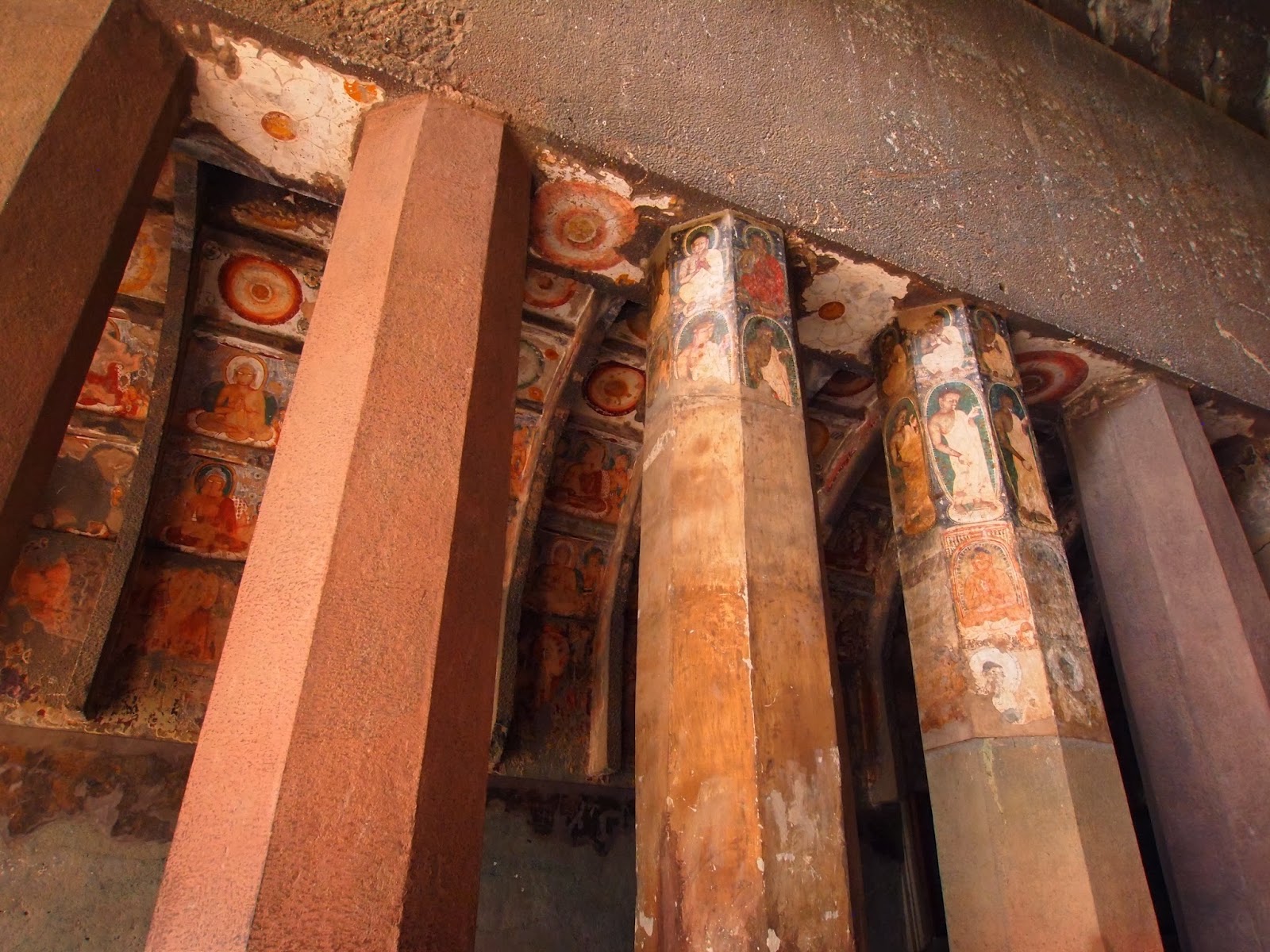
While Aurangabad itself has a few sights of its own, the main reason for visiting was to see the nearby caves of Ajanta and Ellora - two separate ancient networks of caves.  The caves at Ajanta are the older of the two, constructed between the 2nd century BC and the 6th century AD.  They are carved into the cliff face of a dramatic bend in a river and, after being superseded by the caves at Ellora, were forgotten for over a thousand years until they were stumbled upon by a British hunting party.  There are 28 different caves at the site, ranging from the small and relatively unimpressive to grand, vaulted temples.  Incredibly, partly due to their being in ‘hibernation’ and partly due to their protected location, the paintings within the caves are very well preserved, despite some of them being over two thousand years old.

Painting on a cave roof
We had taken up a reasonable offer by the hotel management to hire a driver for a couple of days (the guy who had picked us up from the station) so we were able to make the two hour journey from Aurangabad in our own time, arriving just before midday.  We approached the caves along the river and soon got a glimpse of just how extensive the complex is.  Dense undergrowth had concealed the majority of the caves when the British hunting party stumbled across them – with only a few arches being spotted by one of the men.  Now, however, the cliffs have been stripped of vegetation allowing the caves to be seen in all of their glory.  As we were visiting in the dry season, the scene was very dusty and orange tinted – in the rainy season apparently waterfalls flow over some of the caves and the scene is far greener. 

Team Photo
Unfortunately it soon became clear that we would be sharing the caves with countless groups of school children for the day – though while it was annoying that the caves were all very busy, the kids were really excited to see us westerners and all wanted to talk to us, shake our hands and get photos with us.  One of the school groups actually posed for a class photo with myself and Sergei at the centre, though this was a feeble exercise as the majority of the kids were staring away from the camera – towards us.  I was expecting to see far more tourists – we saw maybe a dozen while we were there and it was very strange to be given the amount of attention that we were.  After seeing the majority of caves we crossed the river towards the viewing point on the inside of the bend which gave a great panorama over the full complex.  It is a really special place and I can’t imagine how exciting it would have been for the British party who discovered them.  Instead of trying to describe them further I will let the photos speak for themselves.


Reclining Buddha statue

Incredible Vaulted Ceiling

A painted ceiling in one of the caves

Sitting at the viewpoint

Share
Tweet
Pin
Share
No comments
The Chhatrapati Shivaji Maharaj Vastu Sangrahalaya
Our train from Mumbai to Aurangabad was to leave in the afternoon, leaving us with one last morning in the city.  We had seen a lot of the major tourist sights in the city already so decided to visit the main museum, formally called the ‘Prince of Wales Museum’ but now called the significantly less catchy (and less British) Chhatrapati Shivaji Maharaj Vatsu Sanrahalaya.  This museum is one of the best in India and we had far too little time to do it justice, but still got to see some interesting exhibitions about Ancient India as well as a visiting exhibition from the British Museum containing the Cyrus Scrolls from Persia.  We grabbed some food for the train from an excellent French patisserie and then made our way over to Dadar Station, one of the many suburban stations in Mumbai, for the six hour journey to Aurangabad.  This journey wasn’t too bad, though the carriage was full of noisy kids and pretty lax parents (amusingly I even saw one mum give her kids a box of matches to entertain themselves with).  We were picked up at the station by a driver from our hotel, the Athiti, where we would be spending three nights.

Inside the museum

Share
Tweet
Pin
Share
No comments

Day One: Colonial District

Taj Mahal Palace Hotel and Gateway of India
If Mumbai cannot be seen from space (which as the world’s 9th largest urban area - with a population of over 20 million people, it probably can be), then it almost certainly can be heard from space.  I have never been anywhere with such an all-encompassing cacophony of noises, from street sellers to car horns to police whistles, all day, all night.  I arrived at Mumbai International Airport from London just after midnight - a decidedly inconvenient time to arrive anywhere.  Luckily I had got chatting to a really nice local girl on the plane who guided me through immigration and, after meeting Sergei my travel companion (who had arrived earlier from Singapore), helped us to find a taxi to our hotel which was about 45 minutes away in the city centre.  The journey turned out to be a bit of a pain as our driver appeared to grow tired of us being his passengers and towards the end of the trip began pointing us towards arbitrary hotels.  After a bit of cajoling we managed to get him going in the correct direction and checked in at about 2.30am.

Sights and Smells at the Sassoon Docks
The next morning we started quite late to try to recover a bit from the late arrival and differences in time zones.  Our hotel (the ‘Sea Green’) was located on the west side of the city in the Churchgate area and apparently was once used by British soldiers – the rooms were reasonably Spartan in their décor but were large and spacious with air conditioning.  We started by heading south to get a feel for the city and to try to get our bearings.  Unfortunately this took longer than planned and I managed to lead us straight past the city centre and into the Sassoon Docks, the main fishing harbour for the city.  This rather pungent detour was actually well worth it as we watched the colourful boats bringing in fish for girls in even more colourful saris to prepare.  The wide range of colours isn’t to say that it was particularly pleasant place to be however – the working conditions seemed pretty terrible really, though everyone smiled and waved as we wandered past.


The Sassoon Docks had given us our bearings so we headed north along the coast towards our goal for the day, the old colonial district.  This area is the main administrative centre of the city and was once one of the main administrative centres of the British colonial authorities, who stamped their authority with an array of beautifully designed structures.  Chief amongst these is the Gateway of India, built at the harbour front as the first thing that King George V would see when he arrived.  Next to this is the famous Taj Mahal Palace Hotel which was actually built by JN Tata (of the Indian company Tata Group), supposedly when he was barred (as a native) from the other colonial hotels.  He would have the last laugh however as the hotel is now the most famous in the city and holds its own with some of the other elite hotels around the world.  It was unfortunately badly hit by the Mumbai terrorist attacks of 2008 and there is now an enormous security presence in the area. 
St Thomas Cathedral

Victoria Terminus
We headed inland from here past a variety of architectural gems – including the old Royal Bombay Yacht Club, the Mumbai Museum, several galleries and the university before arriving at the St Thomas Cathedral which we dived inside to get out of the heat, hustle and bustle.  While the sound of car horns is never too far away, the cathedral was a welcome break and we spent a while looking around the marble memorials commissioned for British military and administrative men from times gone (including some who had fought with Lord Nelson for example).  Our next stop was considerably less exciting but very essential as we both bought local sim cards on data plans, allowing us to receive emails and use mapping services – two services that we thought would really benefit us throughout the trip.  The Vodafone shop took a long, long time due to a combination of slow Indian bureaucracy and massive queues, so by the time we had left the sun had nearly set.  This gave us just enough time to keep going north to arguably the jewel in the colonial architecture crown – the Victoria Terminus, the main station for the centre of Mumbai.  The station looks very similar to St Pancras in London but, in the glow of the Indian sunset it was a really spectacular sight.  We grabbed a quick snack and then wandered around the markets for a while before making our way back to the hotel and then out for dinner at a nearby vegetarian restaurant called ‘Samrat’ which was really wonderful and INCREDIBLY cheap – a full meal with two desserts (the waiter insisted we try several) and a coffee cost about £6.  All in all, an excellent first day in India despite a slow start.


Day Two: Elephanta Island

Arrival at Elephanta Island
I had deliberately overestimated the amount of time we would want to spend in Mumbai to allow us to get settled in and sort some things out for the rest of the trip.  As a result, we were able to get up at a leisurely pace and visited the train station to try to sort out some tickets.  The Indian rail network is the largest in the world, with the largest single workforce of any company and the largest computerised booking system.  Unfortunately despite all of these things, the railway is working way over capacity and trains book up months in advance.  I would have booked my trains accordingly, but unfortunately a new change to the system meant that you require an Indian phone number in order to make bookings – which we obviously were not able to get until yesterday.  This has meant that the majority of trains that I had planned to get had become booked and we were going to either have to swap to overnight buses (uncomfortable and a bit dodgy) or to rely on the railway back up system – a small quota of tickets for tourists, or the so-called ‘tatkal’ or emergency tickets which are released at the last minute.  The problem with tatkal tickets is that they are only available at the stations themselves and locals will queue from the night before to get the tickets that they need.  I made the mistake of buying what I thought was an overnight train ticket for a few days’ time, only to find that I had in fact pre-paid for a tatkal – meaning that to redeem the ticket I would have to turn up to the station again the day before the journey and queue.  Lucky I checked, or we would have been in a bit of bother when we tried to board the train in a few days’ time.


Entrance to the Elephanta Island caves
After spending the morning struggling with Indian bureaucrats (who in fairness to them are doing the best they can with a hugely overstretched system), we decided to head out of Mumbai on a boat trip to the nearby ‘Elephanta Island’ a world heritage site that sits about an hour’s journey away in Mumbai Harbour.  The island is home to a series of caves made around 1500 years ago with some seriously impressive religious carvings and is also a nice way to get away from the sound of car horns.  That’s not to say that the island is free from constant sources of irritation however – as monkeys, accustomed to regular contact with tourists, have progressively grown in courage and are now willing to come pretty close and have even been known to steal cameras and sunglasses.  I have always been pretty wary of monkeys as a bite would have a reasonable chance of carrying rabies – so we gave a wide berth.  A couple of hours gave us enough time to see the majority of the island and its temples and we soon were on our way back on a boat into the city. 

Cricketers at Oval Maidan
Arriving back at the dock next to the Gateway of India we slowly ambled back to the hotel via some of the other colonial buildings and through the city’s central park, Oval Maidan. towards the hotel.  The large park was quite a sight, filled with people playing cricket and flanked by the colonial splendour of the old University of Bombay.  As we made our way through the park, past the cricketers, we were approached by two guys who had broken away from their game to talk to us.  They introduced themselves as Sanjay and Sunny and after chatting to them a while they invited us to drink tea with them on the edge of the park.  The two guys were firm friends but were from quite different backgrounds.  Sanjay was 16 and still in school with the hopes of getting good enough grades to go on to studying Mechanical Engineering.  He explained that he would only be able to get into college if he could save the money and get the grades.  To get the money, himself and Sunny (who was 25) worked as shoe shiners on the street.  We spent a long time talking to them and it was clear that Sanjay was a very bright student – when he heard that myself and Sergei were from Hong Kong he went on to recount all of the dates and key people in the Opium War, for example.  Sunny was obviously not as well off as Sanjay and was shining shoes as a full time job as his father had passed away and he was the main breadwinner for the household.  They explained, over tea, how they struggled to shine the shoes as they only had a few rags stored in a carrier bag – and people only notice shoe shiners if they have a box of equipment and are able to sit in a prominent position (such as a train station) with a uniform.  As they are just two young men with a carrier bag with equipment in, they are routinely totally ignored and on some days make as little as a pitiful 40 rupees (40 pence) per day.  Unfortunately, the box of polish and rags as well as a uniform and permit would cost £25 which was more than they could muster.  Having spent a lot of the afternoon talking to the two of them I was pretty sure that their story was genuine and I was keen to help them so decided to give them the money towards their shoeshining equipment.  I figured the money would mean far more to them then it could ever to me and would slightly soothe my feeling of sheer impotence in terms of doing good in a city which has a slum with a population larger than Liverpool.  The two of them were over the moon and offered to clean by boots straight away, which I felt slightly uncomfortable about as it seemed pretty degrading, but they were keen.


Sanjay, Sunny and myself
I am a big believer in charity being a personal thing that people don’t talk about, but I mention this because I think most people would assume that I had been swindled and I felt, in my opinion, that the two guys were great characters and I like to think that is quite a nice story.  That night as Sergei and I ate our dinner (at the incredible Khyber restaurant – an absolute must visit eatery) I received an email from Sanjay, who had to borrow a computer from time to time to do his homework, saying the following:

hi friends thank you so much that you helped us to progress our life. i can also wish you a happy life, good job , health, money and love i wish you can get this in this year. happy new year you already made our new year happy so this is most memorible thing for us . we going to star our job from day after tomorrow . hi to both of you . alex and sergay  you are like an angel for us in this year. have a good journey
take care
regard from 
sanjay and sunny

From my point of view, receiving that email was the best part of the trip so far.

Day Three: Kotachiwadi and Mahalaxmi

St Theresa’s Church
For our last day in Mumbai we walked north along Marina Drive towards the more exclusive part of town as well as some of the other northern districts.  Heading north along the coast we passed along Mumbai’s beach, which the British called ‘Chowpatty beach’ – and as the local word for beach is ‘Chowpatty’, the British had in their infinite wisdom called it ‘beach beach’.  The beach itself was not too bad, with a broad sandy crescent sat with views back down the coast towards the city.  The water, however, was a different story and must be incredibly toxic.  Easily avoiding the temptation to swim therefore, we moved inland to the predominantly Christian neighbourhood of ‘Kotachiwadi’ which is characterised by its rustic wooden houses and pretty church.  Somehow this part of Mumbai has managed to resist the spread of reinforced concrete monstrosities that blight much of the city and is therefore full of character.  We lingered for a while and stopped at the major local coffee chain (Cafe Coffee Day) for lunch.

Haji Ali Mosque
Continuing north, we saw one of the newest Mumbai landmarks, the skyscraper belonging to ‘Mukesh Ambani’ called Antila.  This is the most expensive house in the world, with 27 floors (in a space that in a normal building would take 60), 600 staff and views over all of Mumbai.  It is thought to have cost as much as $700 million.  In the context of a city with the poverty of Mumbai, the tower appears somewhat distasteful, but I guess that it is a fitting symbol of the rise of India.  Past Antila we eventually arrived at our destination, the Hindu temple of Mahalaxmi and the Haji Ali Mosque.  The former of these was not particularly impressive but is extremely popular with the locals – apparently it is dedicated to the god of wealth so this is of little surprise.  The Haji Ali Mosque however was very impressive, located on a spit of land that is cut off when the tide is high.  Again, very popular, the spit of land was filled with a cross-section of Mumbai society – from well-dressed people on smart phones through to beggars with horrendous ailments.  We did not enter the mosque itself but walked around people watching before grabbing some juice at a nearby stand.
 

Mahalaxmi Dhobi Ghat
The last of our sights in the north was the washing district, Mahalaxmi Dhobi Ghat.  Here, a large amount of the city’s thousands of kilograms of clothes washing is done.  Apparently if you ask your hotel to do your laundry for you, it is quite likely that you will see your underwear hanging up.  We got a great view of the strange district from the bridge next to the station.  We had now walked about 7km in one direction but it was getting to the rush hour so we figured that it might be just as quick to walk back again.  This also allowed us to visit one last sight - the house that Gandhi stayed in when he lived in Mumbai, where he penned his philosophy of non-violence.  The house, called Mani Bhavan, is sat on an upmarket suburban street and is remarkably normal (if wealthy for Mumbai).  There is a museum inside and some of the artifacts associated with the great man, such as his books and sandals.  By now it was getting late so we wandered back along the Marina Drive towards the hotel and in the evening went for our final meal in the city at the high-end (but still cheap by our standards) fish restaurant ‘Trishna’ where we had a great dinner of prawns and swordfish.  The following afternoon we would be leaving Mumbai for our next destination, Aurangabad, though there would still be time in the morning for a few last Mumbai sights.

Gandhi’s House in Mumbai


Share
Tweet
Pin
Share
No comments
Gate of India and Taj Mahal Palace Hotel, Mumbai
India, in so many ways more like its own continent than a country, was always going to take some exploring.  After seeing my younger brother make his way solo from Mumbai to Kolkata over the summer and hearing of his incredible experiences, I was determined to have my own adventures.  The plan is, like Will, to start in Mumbai but instead of heading north and east towards the Burmese border I aim to head south and east from the Arabian Sea to the Indian Ocean before swinging back towards a final rest and relaxation in Goa and then back to Hong Kong for the second semester of my year abroad.  The trip is to be four weeks long and the rough itinerary is as follows:

  • Mumbai
  • Aurangabad - Ajanta and Ellora Caves
  • Hyderabad
  • Hampi
  • Bangalore
  • Kochi
  • Kerala
  • Mysore
  • Goa
I am sure that I will have plenty of stories to blog, so set a bookmark.
Share
Tweet
Pin
Share
No comments
Newer Posts
Older Posts

Search This Blog

About me

About Me


Aenean sollicitudin, lorem quis bibendum auctor, nisi elit consequat ipsum, nec sagittis sem nibh id elit. Duis sed odio sit amet nibh vulputate.

recent posts

Follow Us

Blog Archive

  • ▼  2017 (7)
    • ▼  October (7)
      • South Africa’s 44 blue flag beaches for 2017
      • Europe’s most glam holiday destinations is French ...
      • Alcohol helps you speak foreign languages better, ...
      • Government to cut pilot evaluators for large airli...
      • Nepal POKHARA Day#3
      • Nepal RAMKOT Travel Adventure - Day #2
      • Nepal Bandipur Travel Adventure - Day #1
  • ►  2014 (76)
    • ►  November (8)
    • ►  August (6)
    • ►  July (5)
    • ►  June (10)
    • ►  May (15)
    • ►  April (1)
    • ►  March (4)
    • ►  February (10)
    • ►  January (17)
  • ►  2013 (12)
    • ►  December (1)
    • ►  November (6)
    • ►  September (4)
    • ►  August (1)
  • ►  2012 (27)
    • ►  September (10)
    • ►  August (15)
    • ►  July (1)
    • ►  May (1)
  • ►  2011 (73)
    • ►  September (8)
    • ►  August (15)
    • ►  July (3)
    • ►  June (11)
    • ►  May (24)
    • ►  April (3)
    • ►  March (3)
    • ►  January (6)
  • ►  2010 (27)
    • ►  November (11)
    • ►  September (9)
    • ►  August (7)
  • ►  2009 (14)
    • ►  August (8)
    • ►  July (5)
    • ►  June (1)

Labels

10000 Camellia Blossom Temple airlines Albania Amedi Amediyah Anzac Anzac Cove Aphrodisias Assos Austrian Airlines Erbil Ayvalik Backpacking Iraq Backpacking Kurdistan Baisha Bandipur Basilica Cisterns Behramkale Bekhal Waterfall Berat Bergama Beyoglu Bitola Blue Flag Beaches Blue Mosque Bosnia Hercegovina Budva canada Cappadocia Cerro Ena China Corcovado National Park Costa Rica Crowded House Hostel Dali Dohuk Dohuk Dam Donald Duoyishu Eceabat Education England Ephesus Erbil Erhai Lake Family Mall Erbil Freddy's Hostel French Concession FYROM Galata Tower Gali Ali Beg Waterfall Gallipoli Gloucestershire Goreme Hagia Sophia Halfway Guesthouse Hamilton Road Heraklea Hierapolis Hitchin Boys School Hostel Pangea Hotel Qandeel Huangpu River Cruise Iraq Iraqi Kurdistan Istanbul Jade Dragon Snow Mountain Jajce Jianshui Karst Landscape Kotor Kunming La Fortuna La Gran Vista Lake Ohrid Lalish Temple Lijiang Limestone Lone Pine Cemetary Luijazui Macedonia Montenegro Monteverde Mostar Napal news Osa Peninsular Pacuare Pamukkale Pergamum Pigeon Valley Pliva Lakes Pokhra Port Jim Puerto Jimenez Qing Architecture Ramkot Rawanduz Gorge Red Basilica Red Valley regular Roman Rose Valley Rozafa Fortress San Jose Selcuk Shanghai Shanghai Museum Shilin Shkoder Shkodra Shuhe Skopje South Africa Stone Forest Sulav Suleymaniye Mosque Sveti Stefan Tamarindo The Bund The Confucian Temple Three Pagodas Tiger Leaping Gorge Tirana Topkapi Palace Travel Travel Adventure Travertines Troy Turkey Turtle Sanctuary Twin Dragon Bridge Ulcinj Urban Planning Museum Usichar Volcan Arenal Watermills World Challenge Xinjie Yazidi Yazidians Yuanyang Rice Terraces Yunnan Province

Follow Google +

Unknown
View my complete profile
FOLLOW ME @INSTAGRAM

Created with by BeautyTemplates