• Home
  • Travel
  • Life Style
    • Category
    • Category
    • Category
  • About
  • Contact
  • Download
Powered by Blogger.

C Travel Adventures

facebook google twitter tumblr instagram linkedin
Sunday 20th March - Introduction


I have now acquired a ghost writer for my blog.  Hollie tells me that people won’t read my blog if I don’t start it off with a bang, and nothing packs more of a punch than a Winston Churchill quote.  So here goes.  The great man once said that “the Balkans produce more history than they consume” and I have to agree with him.  For a region with a relatively small population, it has had a disproportionate influence on world history, and perhaps no place more than Belgrade.  Had I been born a few years earlier, I would have been brought up regularly hearing reports on the news about the city, but as it stands the Balkan conflict is consigned to the limbo between history and the present – too young to be taught in schools, but too old to be talked about regularly.  This limbo has impacted on Belgrade, one of the world’s most famous cities, but one that very few people would consider visiting.  However the arrival of Wizz Air at Luton Airport has opened up the Balkans and Eastern Europe to us Western Europeans, giving an unprecedented chance to visit a place that our country was bombing ten years ago.  But don’t think that it’s all about the war.  The city is keen to re-invent itself.

Leaving on a Sunday afternoon, team Serbia (consisting of me, Alex Rule and Hollie Hales) departed for Nikolai Tesla Airport in Belgrade.  And now Hollie wants to take it from here…

Currently drinking a few delicious authentic Serbian beers, Yakovicsh (or alex in his Russian hat), Ruley and I are settling in wonderfully. I must say, I had reservations about how I would adapt to the culture, but it’s a few hours in to our adventure  and I have not taken an instant dislike (there is a Zara across the road from our apartment.) I am very much looking forward to the modern art gallery, the tea and cake at the Russian tsar. I hope I can survive these two for five days. Ellie help me!

…and now back to me.  We got the airport to book us a taxi to the hostel after landing – Serbian taxi drivers are notorious for massively overcharging tourists, and we arrived in the city centre at about 7pm.  Our hostel for our five day stay was the hostel 360, but we were spending our first night in an apartment nearby as there wasn’t enough room at the inn on the Sunday we arrived.  The apartment was…interesting.  It was nice and spacious, but the kitchen drawers were stuffed with plastic bags and a hammer and the bedside drawer was stuffed with fashion magazines, tissues, baby wipes and the remains of a pot of moisturiser.  I guess its more exciting than a Gideon’s Bible.  Giggidy.  That night we went out into the rainy Serbian night to find somewhere to eat.  It was fairly quiet, being a wet Sunday night, so we had our pizza restaurant to ourselves.  On the way back from dinner we bought some cheap beers (60p a pint) and went back to the apartment to watch Serbian tv.


Monday 21st March - Part One: The Citadel

Castle Walls and the Danube, Belgrade

It seems that Serbian beer and food is packed with sugar, because all of us were literally unable to sleep.  We woke up thoroughly cranky and unrefreshed as we packed up and moved across the road into the main hostel, where we would be staying for the rest of the week.  After dropping our bags off, we headed out for an explore.  The dominating feature of Belgrade is the citadel (Kalemegdan), which overlooks not only the old and new towns, but also the confluence of the rivers Sava and Danube and as a result is one of the most strategically important points in the Balkans.  It is located in a park and the turrents and sprawling walls were vast enough for us to spend most of our day there.
Despot’s Gate

We started off by walking down Knez Mihailova, the main pedestrianised shopping street that our hostel is located on, in the direction of Kalemegdan.  The street is like any other European city, with a mixture of local shops and international chains.  The main difference is that there is a mixture of Roman and Cyrillic alphabets, and a mixture of repulsive concrete and attractive sculpted buildings.  The citadel is located at the end of Knez Mihailova, about 5 minutes walk away.  The first monument that we reached in the castle grounds was the memorial to the French troops who died defending Belgrade in WW1 - I didn’t even know France had sent troops here.  From there we walked around the walls.  Alex had a photo inside every single turret. I think he sees this trip as a photo shoot.  Highlights of this wall walk included the Victory Monument, Despot’s Gate, and just general castle stuff.

The Citadel Restaurant
Lunch, as recommended by lonely planet, was at a restaurant in the castle walls overlooking the Danube.  There was, of course, a view tax but the prices were actually fairly reasonable and it was silver spoon service - for under a tenner.  We had planned to eat a snack, but it ended up being a bit of a carnivore’s paradise.  Alex ate an entire farm.  Our salad was a bit of a minefield, as the chef had hidden burning hot chillis in amongst the cucumber and tomato.  Me and Alex now have first degree throat burns, but aside from that it was pretty good.  Once outside we found the restaurant was next to a zoo.  It turned out that the walls weren’t very high, so being students we took photos through the bars. It was quite an odd zoo - beside the standard zebras and giraffes were things like a petting zoo which included friendly animals like rabbits, chickens, pigeons and a peacock.  Needless to say we left this in the “may return later” category.

Our plan was to then go to the military history museum - what with Belgrade being such a wartime city.  Unfortunately, having strolled through the grounds and taken some hilarious pictures with cannons and torpedoes, it turned out that it was shut.  Our lonely planet based tour had been de-railed and with no alternative plan, we went back to the hostel for a 10 minute lie down.  Unfortunately we all forgot to set an alarm and we ended up sleeping until the early evening.  With the day nearly gone and not really much to show for it, we decided to go back to the castle to see it at night - which was pretty, before going out for an evening coffee and tea.

Before (check out the super cheese frappe)
After(ish)
After such a big lunch, we didn’t feel capable of eating another meal, and thought we would just have a delayed dessert at the “Russian Tsar” coffee house - which is famous across Serbia.  We didn’t know quite what to order - there were four pages of cakes to chose from and two pages of coffee.  After much deliberating, I settled on the “Russian Tsar” coffee, with white chocolate profiteroles, Alex went for the Trio Chocolat cake with a frappe on the side, and Hollie chose a Kinder Cake and a hot chocolate.  When it arrived, we found out just why it was famous.  My coffee was loaded with liqueur, Alex’s frappe arrived in like, a fish bowl and was mainly marscapone cheese, and Hollie’s hot chocolate was essentially a bar of chocolate that had been melted down.  That’s not to mention the cakes.  My profiteroles were swimming in a pint of white chocolate, Alex had slab of chocolate and Hollie just about got away with hers.  It wouldn’t be an overestimate to say that there were about 10,000 calories on the table.  Our eyes lit up, and the first bites were glorious.  Unfortunately we realised that there were thousands more gloopy sugary bites where that came from.  To quote the famous Serbian phrase: “too much of a good thing clogs your arteries”.  Hollie finished first and watched in horror as me and Alex ploughed through calorie after calories, each one more repulsive than the last.  By the time we finished, we were in agony, my coffee was cold and Alex’s marscapone had curdled.  But we had conquered the Russian Tsar.  On our way back to the hostel we had to stop at the supermarket to get some juice.  Anything to cleanse our palates and provide vitamins.  While we had only had one meal today, it felt like we had had ten.  We rolled back into the hostel and collapsed on the balcony which is where you find us now.  With ten stone food babies all around and an off the scale cholesterol level.  HAHAHAHAHA believe it or not, Hollie just broke the chair she was sitting on.  Fabulous timing.  See you tomorrow

Tuesday 22nd March - Part Two: Sveti Sava’s, the House of Flowers and Zemun


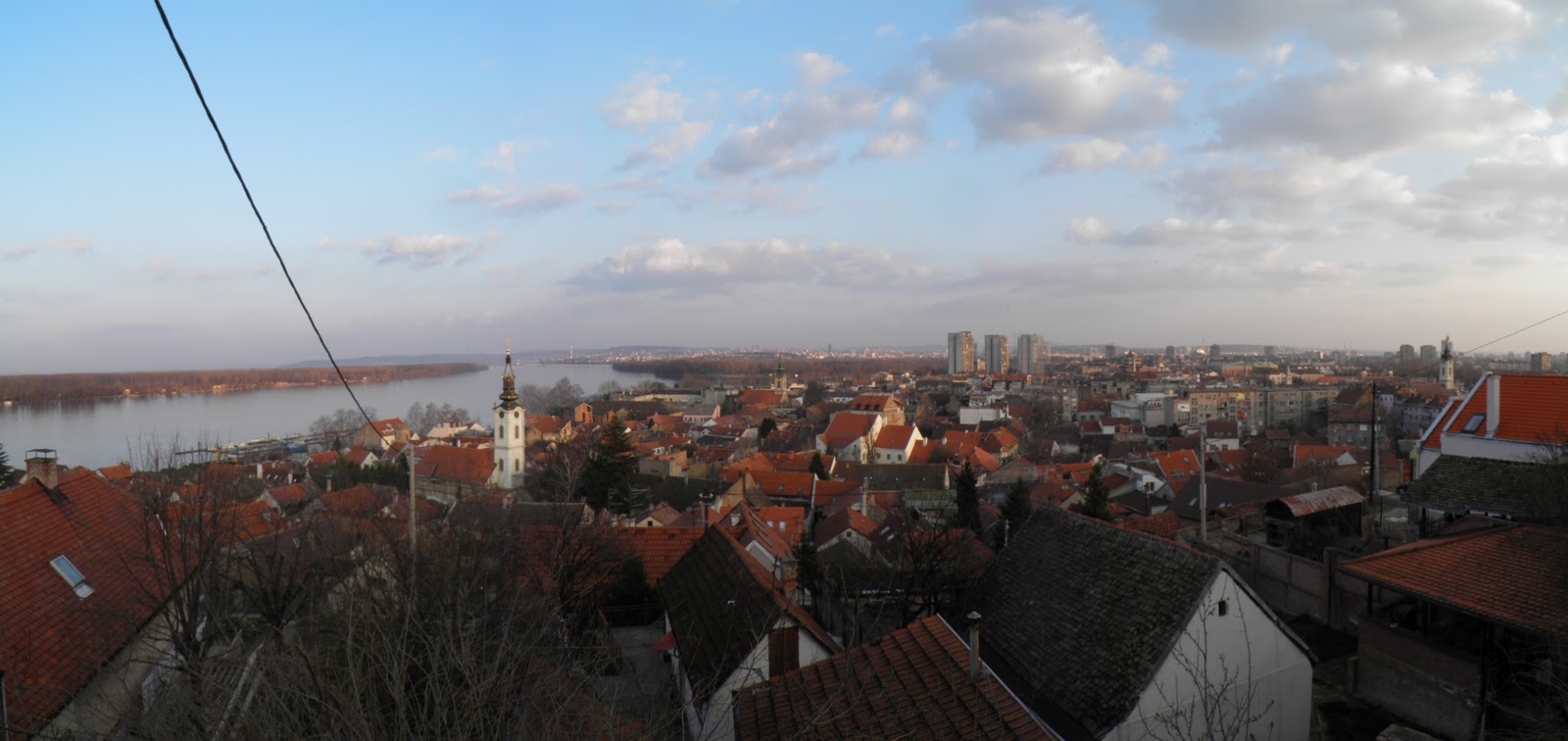
The view of Belgrade from Zemun

Sveti Sava Cathedral

Lonely Planet set aside two days for Belgrade, so on our second full day we headed for the further flung sites that the city had on offer.  The first of these was the Temple of Saint Sava, to the south of the old town, which is the largest Orthadox cathedral in the world.  The grand dome of the building is visible across most of the city and is one of the few aesthetic buildings on the city skyline.  On the inside however, it is completely unfinished and has been for 200 years – and it clearly has a long way to go.  The inside reveals the bare bones of the cathedral structure and is little more than a grand construction site, complete with vast amounts of scaffolding and the odd cement mixer.  And as yet no seats.  It is a hugely impressive building from the outside however – similar in sheer scale to something like the Hagia Sophia in Istanbul and would be worth coming back to one day to see it in its entirety.

From the temple we headed further south, along the side of a motorway through the city suburbs to our next site.  On the way, we decided that we were hungry and, after going over a motorway footbridge, we ended up at some kind of Serbian service station restaurant that Hollie said looked nice.  I can’t fault her on her choice of building, but the restaurant itself was surreal, despite being built like a little swiss mountain hut.  There were no customers and a shy waiter soon arrived with a menu that had no prices and had pictures of the food which seemed to bear no resemblance to the English descriptions beside it, except where the dish was so basic that the English couldn’t go far wrong.  Such as in the case of “plate with two peppers on it”.  After a quick drink we decided that the motorway chalet was a bit too weird to eat at and we moved on to our intended site. 


The House of Flowers
The site in question was a complex of buildings that included the Museum of Yugoslav History and the House of Flowers.  The former of these, as seems to be the way on this trip with museums, was shut.  The latter however, was more than worth the hefty walk across town, as it was the resting place of Tito, the revered leader of Yugoslavia.  It seemed, at first, a strange place for a mausoleum – in the middle of a Belgrade suburb, but after climbing the steps up to it, it became clear that Tito had been buried with a fine view over his capital.  The building itself is a bit like a marble greenhouse with velvet curtains – a bit of an odd choice, but it was apparently Tito’s wish.  The complex is in a bizarre state of disrepair – while the mausoleum itself is spotless (a permanent military guard on the tomb remained for a decade after Tito’s death), the grounds are not.  A large water feature at the entrance to the site was filled with a thin layer of stagnant water along with two old mattresses - and there was an abundance of graffiti.  It seemed like a bit of a desolate place to be buried when compared to say, Napoleon in Les Invalides.


Gardoš, Zemun
The plan from here was to go to Zemun – a “town within a city” on the north western edge of Belgrade.  When Belgrade was a part of the Ottoman Empire, Zemun marked the southernmost point of the Austrian Empire – a real border of east and west about 8km out of Belgrade city centre.  Lonely Planet suggested that Zemun and the House of Flowers would be all in a day’s sightseeing, but forgot to mention that it would include a walk from one end of the city to the other.  Upon realising just what a trek it was, we decided to go ahead with it anyway and set out on the tow path of the River Sava (stopping on the way at a supermarket to pick up some bread and cheese for lunch).  On the bridge over the Sava, we stumbled upon (much to Hollie’s delight) a Serbian film crew who were filming a “walking up stairs” scene.  As we wanted to climb said stairs, we ploughed through the middle of their set and found a place to overlook the filming.  At first we thought something exciting was going to happen – like a fight scene or something, but it soon became evident that the actors were literally walking up and down a set of stairs.  So we quickly moved on.  The River Sava meets the River Danube to the north west of Belgrade, so we soon ended up walking along the Danube tow path.  The weather forecast hadn’t been great, but it was actually a really nice day and lots of the locals were out walking their dogs in the late afternoon sunshine.  I had bought my pedometer with me to Belgrade to see how far a person walks on city tours, but today I think I tainted the data a bit – by the time we had reached Zemun we had walked a total of 9 miles and burned off 1000 calories.  Needless to say we were pretty tired. The town of Zemun is dominated by an Austrian watchtower that overlooks Belgrade and is called the GardoÅ¡.  Lonely Planet describes it as a “misplaced lighthouse” and Hollie said it looked like the tower out of a Series of Unfortunate Events.  Both seem pretty apt.  After a few photos of the tower and its stunning view over Belgrade – a view which was historically vital as a watchtower that separated empires, we had a drink at a nearby tavern with the same awesome view.  In Britain the view tax here would be extortionate, but the tavern was empty apart from a few locals and the beer was about £1 for a pint.  Which wasn’t too bad.  We sat and watched the sun set over the city, before getting a cheap taxi back into the city.

?
Our day wasn’t quite finished yet, as we had one of Belgrade’s top restaurants to visit.  We were eating at the famous “?” tavern – a place that from the name alone would suggest some kind of edgy and chic bar, but which actually couldn’t be further from that.  The tavern is the city’s oldest and was once named after the church opposite.  The church was unhappy however, at having a tavern named after it – believing that it corrupted the name of the church and therefore launched a formal complaint.  The owner of the tavern, not quite knowing what the fuss was about, stuck an exasperated “?” over the existing sign and the name has remained ever since.  The menu was real central European fare – from “calf’s head in tripe” and “young bull glands” at one end of the spectrum, to the more palatable goulash and grills at the other.  We opted for sharing a few dishes (glands not included) to get a real sense of the local cuisine, and it was pretty good.  It was followed by Baklava for desert and, for me and Alex, our first shots of the local liquor – the infamous Plum Brandy, which makes whiskey seem like tap water.  With the lining stripped from our mouths, we headed back to the hostel for a fairly early night – we aim to be up in the morning for a 7 o’clock train.  Whether that happens remains to be seen.

Share
Tweet
Pin
Share
No comments

Thursday 20th January 2011

Lake Geneva, Switzerland
I always feel that flying from a city without visiting it is a missed oppurtunity.  It also leads to problems when it comes to classifying whether or not I have visited a place - I have, for example, caught a plane from Warsaw, but I didn`t actually go to the centre.  To save this administrative error, I decided to curtail the end of my skiing trip and spend a day in Geneva - a city that has always interested me as the home of many many international organizations, as well as being a place of legendary beauty.

CERN, Geneva
I arrived at about 11.00am, having caught the train from Sion, and after dumping my bags at my hostel, set out on the legendary Swiss public transport system (which was free thanks to a travel card that the hostel gave me).  My first destination was CERN - le Conseil Européen pour la Recherche Nucléaire, or as it tends to be known in the British media, the Hadron Collider.  With the one mark dropped on my Physics exam being the catalyst for my gap year, it seemed like not only a fascinating, but also an appropriate place to visit.  Unfortunately a guided tour of the actual laboratory needs to be booked a month in advance (which I found out a week ago), so I went to see the two major exhibits that were on display -  Microcosm (a history of post war European science) and Universe of Particles.  Both were very interesting and were pitched at a level that was accessable to somebody who had done an A level into it - it wasn’t as hard as it could have been.  It was a place that I could have spent days in, but there were other places I wanted to visit in my afternoon in Geneva, so I was only there for a few hours.

Palais de Nations, Geneva
My next stop was the Palais de Nations - one of the European headquarters of the United Nations, and the birthplace of the League of Nations.  It is in many ways the centre of 20th century European history and is all the more worth going to for still being in use to this day for international diplomacy.  In order to get access to the site there is a fairly rigorous security check, which involves a passport check and being given an identity badge.  This wasn’t an inconvenience though, because being given an identity badge made the visit even more exciting.  It goes without saying that members of the public aren’t allowed to just randomly walk around the site so I was obliged to take an English tour with a German tour guide.  This was fairly interesting, but she tended to ramble on about pointless stuff, like how nice the view is from the windows, rather than exploring the various intricacies of international relations.

Original League of Nations conference hall
The palace had been built after the end of World War One as the home of the League of Nations, an international organization that hoped to avoid there being any more bloodshed on a major scale.  Anybody who knows their history will know that the League of Nations was a bit of a flop and after failing to prevent World War Two, was disbanded and replaced with the United Nations, who moved their headquarters to New York.  However, such a large organization requires more than one ‘branch’ and Geneva, along with Vienna, was chosen as the European branch of the United Nations.  On top of that, the Hague in Holland was chosen as the site of the International Criminal Courts.  I hadn’t realised it, but there is also a United Nations headquarters in Nairobi, Kenya.  But that is beside the point.  The Palais de Nations was the obvious place for the United Nations to be housed in Geneva, but it was deemed too small and several new wings have been attached.  The original core of the building is retained however and there are still remnants of the League of Nations - the letters LN on the door handles for example, or the fact that the grand hall is made of materials from each of the founding League of Nation members (granite from Norway, marble from Italy etc).  In my head I imagined there being one large auditorium - the famous one with all the national name plaques, but there are in fact over twenty of such rooms.  The original League of Nations auditorium is the most intricately decorated of these, and is now home to the International Disarmament Committee.  Members of the public are free to sit in on certain meetings and there are a wealth of topics that are discussed - from the state of natural gas reserves to the growing problem of back pain in adults.  While most decisions are made in New York, there are some occasions - such as the war in South Ossetia, where Geneva is preferred for peace talks.  The tour cost 10CHF (about £6.00) and was well worth going on.

Main auditorium, UN
I had spent most of the day at the two sites, so didn’t have any time to go in anywhere else - there is a whole lot more I could have done in the city.  I therefore decided to go for a stroll into town from the UN building, along the lake front.  It was very windy and this unfortunately seemed to mean that the famous Jet d'Eau had been turned off - the lake itself was very choppy, so it wasn’t much of a surprise.  I wandered around the Jardin d'Anglais, where there is a flower clock with the longest second hand in the world.  At this stage it seemed that I was scraping the bottom of the site barrel so I headed to a traditional local coffee house (Star..somethings) and then on for a curry.  Which of course the Swiss are famous for.  Once back at the hostel (the City Hostel - £20 a night for a four bed dorm), I proceeded to give myself a heart attack.  Opening up the locker that I had left my luggage in earlier, I found that it was completely empty - all of the things I had brought with me - the ski equipment, camera etc etc was gone.  I rushed up to reception to report that it had been stolen and the receptionists came down and asked if I had checked the other lockers.  I saw no reason why my stuff would be moved, but followed their advice and lo and behold I found it.  Having placed all of my gear in locker 13 and having shut the door, I had proceeded to put the padlock on locker 12.  Possibly the most stupid traveler mistake of all time.  I left my hostel, disgraced, the next morning and got the early flight back to London Luton.  All in all, Geneva was a very worthwhile city to see, and is a I would love to go back to in the near future.

Windy Lake Geneva

Share
Tweet
Pin
Share
No comments

Sunday 16th January - Thursday 20th January

Tracouet
Not long after coming back from Prague, I headed off on my next adventure, this time to Switzerland to go skiing.  I had never been particularly interested in skiing, but when a friend invited me out to stay in his family chalet, I figured it was a case of trying everything once.  As somebody who tends to get frustrated at being bad at things (think back to how little time I was willing to spend learning to ride a motorbike in Egypt), I decided to go on a “learn to ski in a day” course in Milton Keynes. This proved to be a worthwhile investment as it meant that by the time I got to the Swiss Alps, I had got the basics.  Under the expert tuition of Tom, I was soon able to go from the “snow plough” - a posture that immediately signals you out to everyone else on the slope as a beginner, to parallel skiing.  From there, I was able to enjoy blue and red runs at will.  For non skiers out there, the grades of difficulty that are given to ski runs are categorised as green, blue, red and black, going from easiest to hardest.
A view over Sion from Tracouet

Getting to Nendaz, where I was staying, was very straightforward.  Flights for Geneva left Luton every hour so after finishing work at 3, I got the 6.00pm flight and arrived at about 9 (with a delay and time difference added).  The Easyjet flight was very bizarre - there were only 23 passengers taking up the 120 odd seats, so everyone had two aisles each.  There were so few passengers that I was asked to sit in the seats on the wing for take off as this is where the emergency exits are located and apparently it is law that they have to be manned take off and landing.  I stayed in Geneva for Saturday night, though I didn`t see any of the town as I went straight back to my hostel - I aimed to come back on Thursday to look around a bit.  On Sunday morning I got a direct train to Sion, which is the town in the valley below the Nendaz ski resort.  The journey was fantastic - possibly the best I have ever been on, as it skirted Lake Geneva through the towns of Lausanne and Montreaux, and I was early enough to see the sun rise over the lake.  The sun slowly burnt the mist off, but for the majority of the journey the far bank wasn`t visible - Smoke on the Water.

Verbier
It is difficult to know how to write a blog for something like a ski holiday as every day involved the same activity, just in different places.  But here goes.  Having arrived on Sunday at midday, Tom and I headed for Traquoet, the nearest cablecar station to the chalet.  A free bus service runs between the ski resorts.  I spent the rest of the day consolidating what I had learnt at Milton Keynes by going down blue runs, but I was yet to leave the reassuringly slow snow plow.  My first time on the slopes was remarkably free from falls however - in fact the only time I fell was in an embarassing tangle with Tom when I was putting my skis on, which involved me essentially wearing his skis as well as my own and causing the two of us to go bundling down the nursery slope as a single entity.  I guess it was the worst possible start, but things got better from there.  That evening I was introduced to the other people who were benefiting from Tom and his dad`s generosity and were staying in the chalet with us.  The group was an incredibly eclectic mix - with the financial, aviation, music, furniture and car businesses represented.  Needless to say, the evening was mainly spent listening to the stories that these people had to share.  As well as spending two hours in the jacuzzi.

The ski team
On Monday we headed over to Thyon.  It was here that I actually got the hang of skiing properly and it was strange how it suddenly just clicked - one moment I was slowly wobbling down the slopes and all of a suddent I was flying down and cornering with parallel skis. From there it was a lot of fun.  The days followed a wonderful routine - breakfast, skiing, lunch, skiing, jacuzzi, dinner and this was how I spent my time until Wednesday.  After my first few sessions of being by myself, I joined the others and we skiied as a group.  Our only time when we weren`t as a group was when Tom and his dad went off piste with a guide for a day that was so intense that it resulted in a broken ski for Tom`s dad - a situation that would have caused most people to roll up in a ball and cry, but only resulted in him skiing down an unmarked run on one leg.  Amazing stuff.  We changed where we skiied each day - going to Verbier on Wednesday for my last run and it was here that the weather became overcast and misty, without yielding the snowfall that we had been hoping for.  This was good though, as it meant that my last day of skiing was in harder conditions.  Lunchtime on Wednesday was very impressive - we went to a restaurant called Chez Dany which includes Prince William as its past guests.  As with most good restaurants in the alps, the only way to get to it was to ski down a tough slope to get there, but we all made it and ate in real style.

I appreciate that this probably isn`t the most informative of my blogs and is really the story of how I learned to ski, but I thought I would include it for completeness.  It was a fantastic oppurtunity that came from sheer generosity, which I would have been foolish to refuse.  A thorougly enjoyable week.
Share
Tweet
Pin
Share
No comments

Thursday 6th January 2011

Plzen town centre - with half a man who ruined my panorama
Train journey to Plzen
On our last full day we decided to venture out of Prague again.  This involved me looking at a lot of rail timetables and finding where we could travel to and from in a day.  We eventually settled on the town of Plzen, about 2 hours south west of Prague by train.  It is the fourth biggest city in the Czech Republic and is most famous for being the town that Pilsener, the world’s first lager.  This started with a wonderful train journey, where the line snaked through a canyon beside a river.  Unfortunately, as seems to be the case with most trains in Central Europe, the windows were dirty and it was difficult to get any good photos.  I guess this is the best of the bunch.

Lunch in Plzen with a Pilsener

We didn't really know what to expect in Plzen - lonely planet didn’t really elaborate much on the sites.  Upon arrival it turned out that the city was trying to be European Capital of Culture for 2015, so we expected there to be a lot to see.  Our first stop after a long journey was the local beer hall, where we had the compulsory Pilsener Urquell beer.  The food was traditional and served on a wooden board which had been crafted to include the beer mat - a typical thing to do for such a beer based town.  I was able to look at the map of the town I had picked up and found out that it isn’t only the brewery that it’s famous for.  It also contains the third largest synagogue in the entire world - behind only Jerusalem and Budapest.  However, beyond that, it didn’t seem like we would be able to spend much time there.
Plzen Synagogue

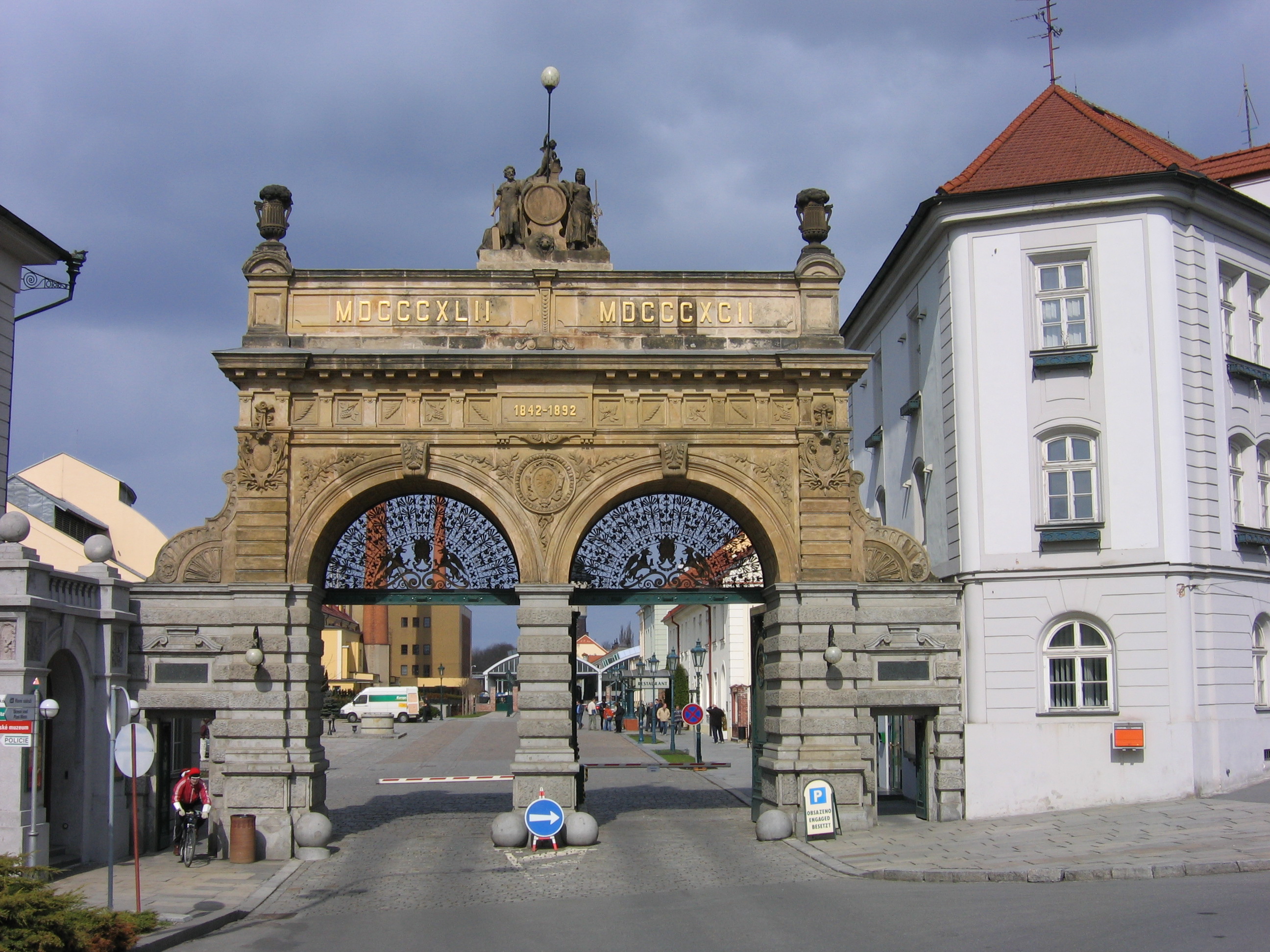
Willing to give the town a chance though, we headed from the beer hall towards the town centre.  This was tough in itself though because, just like Kutna Hora, the roads were really icy.  From the beer hall we headed to the synagogue, via the town square.  Despite being the third largest in the world, the synagogue was closed - so with no other major sites we headed back for the station.  There was nothing particularly impressive or bloggable about the town - I am struggling to find stuff to write about.  On the way back to the station we saw the old Brewery Gate where the horse and carts used to enter the city with kegs of beer.  There was a Pilsen museum, but we didn’t really have time for it, without missing the only train to Prague with a reasonable time.  It was worth going to Plzen - to say that we have been there, but it felt a bit like we had spent 4 hours on a train for the sake of a beer.  It is definitely somewhere to go to on your way through the Czech Republic, but possibly not somewhere to base a trip around.  Unless you are a real beer fan.
Brewery Gate, Plzen
Share
Tweet
Pin
Share
No comments

Tuesday 4th January 2011


Kutna Hora panorama

On our third day in Prague, we decided to go and explore the rest of the country a bit. Having both interrailed in the summer, we decided the best way to get out of the city would be by train. Our chosen destination for this journey was the town of Kutna Hora, about 60 miles south of Prague.  The town had once been the country’s second city having felt a boom when silver was discovered in the hills there.  as a result, it is renowned for its elegant buildings, palaces and cathedrals and is now a UNESCO World Heritage Site.  However, it was not these sites that drew us to the town, as we had heard about a place called the Sedlec Ossuary.  After arriving at a small and relatively deserted station with no idea which direction to go, we followed the first rule of travelling in a tourist destination and followed the Japanese people with the big cameras.  Sure enough, they led us right up to the entrance.


Sedlec Ossuary, Kutna Hora
Bone Chandelier 
City Coat of Arms. Literally.
See, it’s a church too
The Ossuary is a small monastery in a graveyard on the edge of town.  From the outside it appears to be fairly insignificant, but inside are the remains of 40,000 human bodies.  The skeletons of these bodies, which were either victims of the Hussite Wars or of the Black Death, had centuries ago been meticulously arranged by a half blind monk into a variety of objects, such as a chandelier and a coat of arms, as well as being attached to most of the free wall and ceiling space and piled into four large mounds of skulls and bones.  It ought to have been a sombre place - it contained over a hundred times as many bodies as the amount of British soldiers that have died in Iraq and Afghanistan to date - packed into a small church, but strangely the overwhelming feelings in the building were curiosity and awe.  It was as though nobody was quite willing to acknowledge that every skull represented a human being.  The strangest thing of all was that, despite appearing to be what I imagined hell to look like, it was a place of worship and amongst the skulls and bones were crucifixes.  It is a fascinating place and one ot the most unique I have ever been to.  It’s also very accessible from Prague - a £4 return tourney lasting just under an hour.

Saint Barbara Cathedral, Kutna Hora
With the logic that, interesting as it was, the Ossuary alone couldn’t have warranted the town’s UNESCO status, we thought that there had to be a few more places to see and headed towards the town centre.  This meant a half hour walk through the town’s suburbs on which we saw pretty much no locals.  It was like a ghost town.  This theme continued in the town centre - while there were a few people going about their daily business, the seemingly sparse population was totally out of character with the grand buildings.  The centre of the town had been built by King Wenceslas amongst others and featured two cathedrals and several palaces. Our plan was to only spend about 2 hours in the town, but after looking around the Saint Barbara church and a few squares it became apparent that the transport system in the town was very confusing.  Our train tickets from Prague allowed us to travel from the Kutna Hora Mesto station, but it wasn’t marked anywhere on the maps we had.  To get around this, we decided to follow the train line until we met the station.  To add to this confusion, the icy paths and roads made it impossible to move with any pace and the fact that the town was built on a hill only worsened the problem.  To cut a long story short, we found the station 10 minutes after the train back to Prague had left, with the next one departing two hours later.


Inside the Cathedral
Having done pretty much everything of interest in the town, and with two hours to spare, we headed for a restaurant to warm up a bit.  The food was good and wasn’t too expensive.  I picked up a map from a tourist office and found a few other little sites to look at.  With plenty of time to spare, we ambled back towards the Mesto station, from which there was a train to the station on the outskirts (where we had arrive), where we would change for one back to Prague.  It wasn’t quite that simple however as, despite the journey only being six minutes long, there was another station between the town centre and the outskirts.  It hadn't occurred to me that a town of 20,000 people would need three train stations, so we got off the train, only to find ourselves at the wrong station and lost.  What ensued was a mad dash from this middle station to the outskirts, along icy streets.  In said mad dash I slipped over and Ellie nearly got hit by a car (the fact that I pulled her back from it is her present for it being our six month anniversary), but we got there.  Just. This was a massive relief as the idea of spending two hours in a tiny Czech railway station, the only entertainment in which was a coffee machine, was massively depressing.

Italian Court, Kutna Hora
I write this from the train, where apart from the conductor telling us we had the wrong tickets and charging us fro new ones, things have gone smoothly.  Having had a chance to see the map of Kutna Hora, it is clear just how strange it is.  The town has 20,000 people, but has double that number of human skeletons hanging up in a church in its suburbs.  It has two massive cathedrals, three train stations and a palace built by the Czech national hero, King Wenceslas.  If that wasn’t enough, having looked at the map I have found it has loads of museums, including a silver museum, a cigarette museum and a “baby prams from 1860-1960” museum.  All this and the streets are basically deserted.  If in Prague, this curiosity of a town is well worth a visit.
Share
Tweet
Pin
Share
No comments

Sunday 2nd January 2011

Old Town Square, Prague
I am now 3 months into my impromptu gap year.  Seeing as I ended my European travels with next to no money, I have spent most of this time building up my bank balance (apart from my two week excursion to Egypt).  It turns out that when you aren’t earning money or travelling, gap years give you a lot of time to yourself which, in my case, is spent planning where to travel to.  This desire to plan everything, combined with the amount of free time I now seem to have has led me to pin up on my wall the many National Geographic maps that I have gathered, before acupuncturing them in the places where I have been.  Thus far in my life, the European map is by far the most impressive, but there is one gaping hole in my travelling repertoire - Prague, and the Czech Republic in general.  Those of you who read the Overlord blog, which documented my last trip to the continent, will know that after a frantic sprint around the Viennese metro, I was two minutes away from visiting Brno in the south of the country - missing the train.  After such a disappointment it was only a matter of time before I planned a visit to the city of a thousand spires.  Just because its a romantic trip with my girlfriend doesn’t mean I can’t right a blog, right?

Astronomical Clock, Prague
This trip is a little different to my last travels, in that I have booked 5 days in an apartment in the centre of Prague and aim to use this as a base to visit other cities in the Czech Republic, Poland or Eastern Germany.  I have yet to decide where we will go.  However the key destination is Prague itself and after arriving in the city at 11 this morning, we have started to explore a bit.  Our apartment is located right next to the National Theatre (the statue on the roof is the main sight from our terrace), so we have a nice central location on the east bank of the Vltava, to the south of the Charles Bridge.  We started with a random meander around the city, which started with coming across the infamous Astronomical Clock in the Old Town Square.  The clock is very impressive, but is known for being very unimpressive and it didn’t disappoint - it is amusing just how insignificant the actual chime was when it struck 11.  The Old Town Square itself was pleasant however as the Christmas Market hadn’t left yet and there was a big Christmas Tree in the centre.  The Christmas theme continued as we walked from the square to the Charles Bridge as not only were decorations still up, but there was a fair bit of snow still around.  The paths were cleared, but the roofs of buildings were white and big snow piles had been made my the sides of the road.  The Charles Bridge is the most famous crossing of the Vltava and is one of the most well known bridges in the world, due to its being adorned with over a dozen statues of saints.  It is also the bridge from the first Mission Impossible film.

Charles Bridge, Prague
I know that there isn’t much historical context (or architectural/artistic knowledge), but that is because I don’t know much yet (the overly American based content of my school history course has left me fairly clueless about European history).  However we hope to amend this at some stage by going on a walking tour.  For the time being this means I will just say where things are and what I thought of them.  After a spot of lunch near the Charles Bridge at a local cultural restaurant that most definitely wasn’t McDonalds, we headed towards the Petřín Hill.  The hill is quite bizarre as it dominates the skyline of the west bank of the Vltava, but is actually pretty empty - imagine if you were walking down Oxford Street and somebody had turned Hyde Park into a big hill and you get a rough impression.  Looking down at the city from the top of the hill we were surprised to see just how small it seems.  Having seen Slovakia’s Bratislava and Slovenia’s Ljubljana, I have seen how newly emerged countries can end up with small cities as their capitals which had been bit parts of the Austro Hungarian Empire.  Somehow I expected Prague to be different - I would rank it up with the most famous cities in the world. Yes, it is still considerable bigger than the aforementioned examples, but there is no sign of it just being one large urban sprawl.  While there are a few sporadic concrete monstrosities on the skyline, the city centre and surrounding area seems to have retained much of its character.  At least from what I could see from the Petřín Hill.  Our plan was to go up the “Belvedere” - a small imitation of the Eiffel Tower, but frustratingly we couldn’t find our way to it.  Despite it being an obvious landmark on the skyline.


The vague sightseeing of the early afternoon had only really happened because we hadn’t been able to go to the apartment, so after coming down the hill we headed back across the Vltava to pick up the keys and have now basically crashed in the apartment, due to our 3.30am start this morning.  We want to be up bright and early for tomorrow’s excitement.  The content of which we have yet to decide.
Oh, and Ellie is awesome. 
Prague Skyline from Petrin Hill

Monday 3rd January 2011
National Museum, Wenceslas Square, Prague
After a brief walking tour of Prague yesterday, we continued to look around the city a bit more today.  We started by heading towards Wenceslas Square.  While I had heard of this square and assumed it was fairly important, I had no idea what it was so headed over.  We missed it first time, because stupidly Wenceslas Square is actually a Wenceslas Rectange - a wide road more like Champs Elysees than Trafalgar.  It is the economic centre of the city and is dominated by the grand National Museum at one end of it.  Whilst walking up the “square” it started to snow heavily.  The Czechs appear to be well prepared for snow however - we saw a group of officials cleaning the snow off the top of bushes with brooms.  It seems that Czech hedgerows are better cleared than British runways amusingly.  We went in the National Museum’s lobby, but having read that it was only for people who had a day to kill or had a specific interest in an exhibit, we gave it a miss and walked to the station to buy our tickets for tomorrow’s trip.

Jubilee Synagogue, Prague
Despite my extensive European rail travel last year, I hadn’t actually bought a ticket from a European station - as I had used my interrail.  The Czech Republic, it seems, is a bad place to start, as it is a very complicated language and there was no translation.  After A LOT of guess work and shutting my eyes as I put my card in the machine, we got what seemed to be tickets to Kutna Hora.  Prague station was very impressive though and we decided to have our lunch here.  Our next stop was the Henry Tower and the Powder Tower - two old buildings surrounded by modern ones between the station and the old town.  On the way to the towers we stumbled across the Jubilee Synagogue, a wonderfully ornate building which is down a random side street.  The Henry Tower is fairly similar to the other older buildings in the city and while it is possible to climb it, the surrounding high rise buildings hide any view somewhat.  The Powder Tower however is very pretty and is located next to one of the city’s theatres in Republic Square.  It is also next to a huge shopping centre which is bigger than any other I have seen.  The Czechs seem to be obsessed with shopping centres and department stores - large swathes of the city are dedicated to shops. They are also very confusing and Ellie got a bonus half hour in a shopping centre as I desperately searched for a toilet.
Republic Square, Prague

After the towers we headed for the Old Town Square again where we happened to stumble across the Astronomical Clock again.  After Ellie made me watch it again (she loves it), we climbed the tower that it is attached to, for what is meant to be one of the better views over the city.  It was a nice clear day - the snow and clouds had cleared and it was crisp and sunny, so we got a good view. Unfortunately the cathedral in the square was closed, so we have yet to go inside the predominant landmark on the city skyline.

Prague Skyline Panorama
After a final bit of sight seeing we headed to the supermarket as, being in an apartment rather than a hotel and being half student as a couple, we were doing our own food. Or more, being only half able to cook as a couple, I was doing our own food.  The supermarket had a pretty shocking selection annoyingly, so we settled on salmon in a white wine sauce.  Apart from the fact that Ellie had to serve her sauce through a sieve, I think that it was a roaring success.  Cooks have to start somewhere.
See, a roaring success
Wednesday 5th January 2011


Prague skyline at night
Having explored the majority of the east bank in the day and a half we had already spent in Prague, we headed for the west bank for what would be our last full day in the city.  We crossed the Vltava at the bridge opposite the National Theatre and stopped on an island in the middle of the river to take photos of the Charles Bridge.  Whilst on this island, happily snapping away, we heard a sudden loud voice that seemed to blare out across the entire city.  The voice spoke in Czech but was followed by a similar one in English which said that something was going to sound continuously at 12 - in about ten minutes time.  Curious as to what this was, and also as to how a voice could be projected over an entire city, we waited on the island to see what happened.  Bang on midday, a piercing siren sounded - far louder than the voice had been.  It sounded like a fire alarm, but over the entire city and we still had no idea what it was.  All I can think of is that it was some kind of warning system if the city was to be nuked.  I have attached a video with the sound on so you can see what I mean.

St Nicholas dome
Thoroughly freaked out by the siren, we carried on to the west bank to see the rest of the main city sites.  This started with a visit to Mala Strana, the district near to the castle where the old aristocracy used to live.  The elegant city streets have now seen the majority of their buildings turned from palaces and stately homes, to embassies or government buildings.  This was unfortunate as it meant that they weren’t really open to the public.  The main building in the area - the Wallenstein Palace was only open on the first weekend of the month.  We didn’t spend that long in this area as a result of it being -7 degrees and nowhere being open.  The exception to this was the St. Nicholas Church, one of the most recognizable domes on the Prague skyline.  We spent a fair bit of time in here - partly to warm up and partly due to the grand structure and decoration of the church itself.

St Vitus Cathedral
After the Mala Strana district, we headed up to the Hradcany district where the castle and other important sites are located.  On arrival at the castle - which dominates the entire city, it became clear that something major was going on.  Barriers had been put out and crowds had gathered around the main street.  Our first guess as to the reason of this was thinking it was a state visit, but after waiting at the barrier for a while and seeing nothing, we decided that it wasn’t worth staying and headed towards the St Vitus Cathedral.  The cathedral is the most important religious building in the city and frustratingly shut at 2.40pm on this particular day due to the mysterious event that was occurring.

Ridiculous Italian man on the right
While we were a bit annoyed but able to get over the fact we had arrived at 2.45pm fairly quickly, the Italian man behind us got VERY angry.  As a result of this, Ellie and I subtly stalked him for the next 45 minutes as he went on a rampage, complaining to everyone in sight.  This started with an argument with the guy at the entrance to the cathedral that got so loud that a policeman came over with the sole contribution of repeatedly tapping the closed sign and brushing off the Italian man’s English pleas with “no, Cesky”.  As uncultured as it sounds, we decided to put the sites of the castle off for a bit to continue hearing the Italian trying to complain in potted English.  His next stop was the tourist office, where he called the manager and went on the explain how he felt that he was being discriminated with because he was Italian (Czech residents were still allowed in as part of the unknown event) and how the tourist officials should let him in as “the Czech Republic is a country with a history of liberty and freedom”.  I have attached a picture of this man, so if you ever meet him you can tell him he is ridiculous.

It was then that we found out what the crowds were there for.  We had seen a lot of kids in costumes of the three kings and it turned out that there was to be a parade through the castle in celebration of it being the twelfth night.  This kids in costume were one part of the parade, but the main attraction was three men who road camels at the front of the procession to a mock stable.  It was quite a spectacle and possibly the only time I will see camels walking along a snowy road.  After watching the majority of this parade, we headed back across the castle district to the Cathedral to climb one of the towers as it had now gone dark.  This was a superb time to climb the tower and we were able to get some fantastic views and really finish off the Prague part of the trip in style.  Aside from briefly going to the Charles Bridge on Friday morning, we didn’t venture out into the city again.

U Flecku Beer Hall, Prague
Before leaving however, we decided to get the smallest of tasters of Prague’s famous nightlife.  It wasn’t the kind of trip where we were going to spend the entire night on pub crawls, but we did decide to go to a nearby beer hall.  Apparently the locals don’t like it as it is “too german”, but having been to the beerhalls in Germany, I didn’t really see that as a problem.  It was the kind of place where a man walks around with glasses of beer for you to just grab, and where people sit on long benches next to each other, rather than on individual tables. It also included a man playing an accordion - a variety of traditional tunes mixed with foreign stereotypes whenever he ended up at a table of tourists (Skippy the kangaroo for Aussies, Yellow Submarine for Brits etc).  This was all part of the fun though and the beer, which was brewed on site, was really good.  As you probably gathered from my European blog, beer halls are a big must.

St Nicholas Church

Share
Tweet
Pin
Share
No comments
A selection of week long excursions into Europe, from New Year in the Czech Republic, to learning to ski in the Swiss Alps, to going off the beaten track in Serbia.

The following trips are shown:
- Prague/Kutna Hora/Plzen, Czech Republic - January 2011
- Geneva/Nendaz, Switzerland - January 2011
- Serbia - March 2011

CLICK HERE TO ENTER

Share
Tweet
Pin
Share
No comments
Newer Posts
Older Posts

Search This Blog

About me

About Me


Aenean sollicitudin, lorem quis bibendum auctor, nisi elit consequat ipsum, nec sagittis sem nibh id elit. Duis sed odio sit amet nibh vulputate.

recent posts

Follow Us

Blog Archive

  • ▼  2017 (7)
    • ▼  October (7)
      • South Africa’s 44 blue flag beaches for 2017
      • Europe’s most glam holiday destinations is French ...
      • Alcohol helps you speak foreign languages better, ...
      • Government to cut pilot evaluators for large airli...
      • Nepal POKHARA Day#3
      • Nepal RAMKOT Travel Adventure - Day #2
      • Nepal Bandipur Travel Adventure - Day #1
  • ►  2014 (76)
    • ►  November (8)
    • ►  August (6)
    • ►  July (5)
    • ►  June (10)
    • ►  May (15)
    • ►  April (1)
    • ►  March (4)
    • ►  February (10)
    • ►  January (17)
  • ►  2013 (12)
    • ►  December (1)
    • ►  November (6)
    • ►  September (4)
    • ►  August (1)
  • ►  2012 (27)
    • ►  September (10)
    • ►  August (15)
    • ►  July (1)
    • ►  May (1)
  • ►  2011 (73)
    • ►  September (8)
    • ►  August (15)
    • ►  July (3)
    • ►  June (11)
    • ►  May (24)
    • ►  April (3)
    • ►  March (3)
    • ►  January (6)
  • ►  2010 (27)
    • ►  November (11)
    • ►  September (9)
    • ►  August (7)
  • ►  2009 (14)
    • ►  August (8)
    • ►  July (5)
    • ►  June (1)

Labels

10000 Camellia Blossom Temple airlines Albania Amedi Amediyah Anzac Anzac Cove Aphrodisias Assos Austrian Airlines Erbil Ayvalik Backpacking Iraq Backpacking Kurdistan Baisha Bandipur Basilica Cisterns Behramkale Bekhal Waterfall Berat Bergama Beyoglu Bitola Blue Flag Beaches Blue Mosque Bosnia Hercegovina Budva canada Cappadocia Cerro Ena China Corcovado National Park Costa Rica Crowded House Hostel Dali Dohuk Dohuk Dam Donald Duoyishu Eceabat Education England Ephesus Erbil Erhai Lake Family Mall Erbil Freddy's Hostel French Concession FYROM Galata Tower Gali Ali Beg Waterfall Gallipoli Gloucestershire Goreme Hagia Sophia Halfway Guesthouse Hamilton Road Heraklea Hierapolis Hitchin Boys School Hostel Pangea Hotel Qandeel Huangpu River Cruise Iraq Iraqi Kurdistan Istanbul Jade Dragon Snow Mountain Jajce Jianshui Karst Landscape Kotor Kunming La Fortuna La Gran Vista Lake Ohrid Lalish Temple Lijiang Limestone Lone Pine Cemetary Luijazui Macedonia Montenegro Monteverde Mostar Napal news Osa Peninsular Pacuare Pamukkale Pergamum Pigeon Valley Pliva Lakes Pokhra Port Jim Puerto Jimenez Qing Architecture Ramkot Rawanduz Gorge Red Basilica Red Valley regular Roman Rose Valley Rozafa Fortress San Jose Selcuk Shanghai Shanghai Museum Shilin Shkoder Shkodra Shuhe Skopje South Africa Stone Forest Sulav Suleymaniye Mosque Sveti Stefan Tamarindo The Bund The Confucian Temple Three Pagodas Tiger Leaping Gorge Tirana Topkapi Palace Travel Travel Adventure Travertines Troy Turkey Turtle Sanctuary Twin Dragon Bridge Ulcinj Urban Planning Museum Usichar Volcan Arenal Watermills World Challenge Xinjie Yazidi Yazidians Yuanyang Rice Terraces Yunnan Province

Follow Google +

Unknown
View my complete profile
FOLLOW ME @INSTAGRAM

Created with by BeautyTemplates