• Home
  • Travel
  • Life Style
    • Category
    • Category
    • Category
  • About
  • Contact
  • Download
Powered by Blogger.

C Travel Adventures

facebook google twitter tumblr instagram linkedin
“below us we could see Budva, a walled town on a round peninsula, a little white tortoise against the blue sea”

It was a two hour journey north from Ulcinj to the major tourist town of Budva, north up the coast on the cheap and reliable Montenegrin bus service.  As Budva is renowned for its beaches I have to admit that we didn’t do anything on the first day apart from swimming and eating on our first day, from our base at the Hippo Hostel on the edge of town.


Sveti Stefan, Montenegro
The next day we started by getting a bus on a short 20 minute journey back down the coast to the exclusive resort of Sveti Stefan.  The resort was one of the classiest in Europe during the Yugoslavian days with clients including Doris Day and Queen Elizabeth II, but seemed to be in a bit of a transition period when our Lonely Planet was published 3 years ago.  As a result we didn’t know how much we would be able to see.  The tiny island itself, connected to the mainland by a small narrow spit of land is amongst the most photographed places in the Balkans.  Unfortunately when we arrived, as dramatic as it was, it was clear that it was the island itself, rather than any specific buildings on it that, that was the hotel and access was for clients only.  To prove to you just how exclusive the whole place was, access to two of its beaches was available however it came at the price of 20 or 50 euros.  Having planned to spend our entire morning there we found that, as mere mortals, there was only enough for half an hour of photo taking before we turned round and headed back to Budva.


Budva Old Town

We hadn’t done any sightseeing in Budva itself so we spent our afternoon there with longer than we had expected.  The town is dominated by its large beach, covered with Russian and Ukranian sunbathers, but there is also a pretty walled old town that was built by the Venetians in their distinctively attractive style.  We paid to enter the citadel which essentially just allowed us onto the highest section of walls, from which we were able to get some great photos of the town and the bay.  A beach lies beside the castle walls and it is possible to swim here to get a sea view of the town.  We spent the rest of our afternoon here before turning back to the hostel, having a meal at a typical Balkan grillhouse on the way back.


The sea against Budva walls

Share
Tweet
Pin
Share
No comments

We got up in Shkoder for our last ample Albanian breakfast at the Hotel Colosseo.  Today we would be travelling from northern Albania to southern Montenegro.  We had heard that furgons departed for Montenegro occasionally, however as we had not come across any we would be taking a taxi who was willing to complete the fifty-odd kilometre journey (including a stop at the border) for 25 euros.  The journey to the border was mainly on country roads and as we were near the edge of the country we saw far more Hoxha bunkers than we had seen elsewhere.  The border crossing was fairly painless and we were soon on our way to Ulcinj where we arrived at 1pm.

Ulcinj Bay
Ulcinj was, until the end of WW1, an Albanian city before the Montenegrins invaded and as a result the population is around 70% ethnic Albanian.  The seaside town is popular with Albanians themselves as well as Europeans who would like to sample a bit of Albanian culture without taking a plunge into the country itself.  It was also an infamous pirate grotto in times gone by.  Unfortunately the taxi driver didn’t know his way around and as a result of a mix up with the driver whereby he interpreted my pronunciation of “plaza” as “plage”, he left the town and drove us several kilometres down the coast to a nearby beach.  It was here that we were dropped by our Albanian taxi driver and had to swap him for a local who knew where our hostel (Stevo’s Guesthouse) was.  This was all a bit of a waste of time and money, but we got there eventually.

Having checked in and got orientated we walked south down to the beach that we had ironically been dropped at earlier but hadn’t wanted to sit on with our rucksacks.  The walk was longer than we expected and instead of passing the two headlands that I had pictured in my head, we ended up going around seven or eight - so needless to say we were very up for a swim when we got to the beach.  The beach itself was relatively pleasant, however it was quite windy and the water was so shallow that it was a bit of a hike out to sea to get your knees wet - we felt pretty refreshed afterwards though.  The walk back didn’t seem so bad because we were out of the heat of the day.  After going out for a meal in the evening we explored Ulcinj itself.  While it is not as famous or dramatic as towns further up the coast, the pretty little beach is still popular and crowded (hence our walk down the coast) and the old town on the cliffs is very picturesque, especially at night.  We had only visited Ulcinj as a stop over on our way north from Albania, but as stop overs go it was very pleasant.

Share
Tweet
Pin
Share
No comments
Downtown Shkoder
Visiting the town of Shkoder was very much an after thought in the great scheme of the trip.  Having visited Serbia, Montenegro and Croatia already on my travels, it was going to be a challenge to get from Albania or Macedonia, to Bosnia.  The original plan was to get back from Albania to Skopje before getting an overnight bus through Serbia to Sarajevo.  As it worked out however, we found that it is possible to get from northern Albania to southern Montenegro by taxi, meaning that I will be revisiting a lot of places I have already seen for the next week, but as I think Montenegro is one of the best places I have been, this isn’t really a hardship.  It also should mean no more overnight buses.  Shkoder is the main gateway from Albania to Montenegro as it is located by Lake Skada, a lake that is mainly Montenegrin but is named after Shkoder.  To get from Berat to Shkoder we decided to test the furgon system out by getting a furgon from Berat to Tirana and (deciding we didn’t want to waste another night in Tirana) we aimed to get a connecting furgon to Shkoder.  I think that it is proof of how good the furgon system is that the first furgon was kind enough to take us to the point where the second one left - and what was actually quite a complicated journey only took just over four hours.  By the time we got to Shkoder though, where we are staying at the Hotel Collosseo, there was only enough time for a little explore of the pretty town centre before getting some dinner.  The hotel is a four star place (though costs about 25 pounds each per night) as nowhere else was responding to the emails I sent out to make a booking.  I’m sure that we will survive - though the advertised swimming pool hasn’t actually been completed yet and having the same thing happen in Vladivostok it is getting pretty annoying.

View from the castle
The next morning we got a taxi to the Rozafa Fortress above the town.  The castle, originally built by the Illyrians but added to by Venetians and Ottomans, is named after a woman called Rozafa who is set to have been buried alive in the walls as an offering to the gods to make sure the castle would stand.  Apparently she requested to have two holes drilled above her so that she could still breastfeed her children (this whole legend is one of the oddest I have ever come across).  Shkodra stands at a real tactical spot, overlooking several major rivers and with the coast and Lake Skada nearby.  The views from the castle were really good and the castle itself was in pretty good condition.  Walking around it was an adventure in itself as it was fairly deserted and there were none of the ‘closed to the public’ areas you would find at English castles, which meant that we could explore any mysterious staircase that we felt like.  The large amount of open wells and crumbling arches meant that we didn’t get TOO adventurous.

The Ottoman Bridge, Shkoder
It must have been one of the hottest days we have had so far and by the time it had got to midday it was unbearable in the heat, so we went and sat in our room and watched some of the pretty good action films that are on Albanian TV.  When it had cooled down a bit we went back out and hailed another taxi (it turned out to be the same guy) and made our way to an old Ottoman bridge on the edge of town.  Our driver can’t have exceeded about 15mph on the way, because he didn’t want us to be uncomfortable on the potholed roads.  He drove a Mercedes and this brand of car is quite a talking point for travellers.  There are more Mercs per person in Albania than in Germany itself - according to the Independent, three out of five cars in the country are Mercedes, but as many as 80% of these are thought to be stolen from the richer European countries.  They are definitely everywhere and the amount of British number plates far exceeds the amount of British people that we have met.  Anyway, back to the bridge, when we arrived we found that as scenic as it was, the water that flows under it has either dried up in the heat or has been diverted, leaving it as a bridge over a dry and rubbish filled valley.  It has been the story of our Albanian experience really - a fair bit of potential as a tourist location, but (and it isn’t much of a surprise) in desperate need of some TLC.


Share
Tweet
Pin
Share
No comments

The public transport system in Albania may lack timetables, but what it loses in reliability it makes up in flexibility with the furgon system.  Furgon is the Albanian word for van or minibus and is the main way that locals get around - essentially any vehicle, ranging in size from people carrier to bus, will stop and take people to the place that they are advertising in the front window.  It is essentially a massive share taxi scheme and it works extremely well, as long as you can find out where the furgons to a certain city tend to hang out.  To do this we got a taxi from the hostel to a random street corner where a lot of cars with ‘Berat’ in the window were.  It cost us 500 leke each (about three pounds) for a two hour journey and was quick and surprisingly comfortable, despite the insane driving of Albanian motorists.


View from the hotel
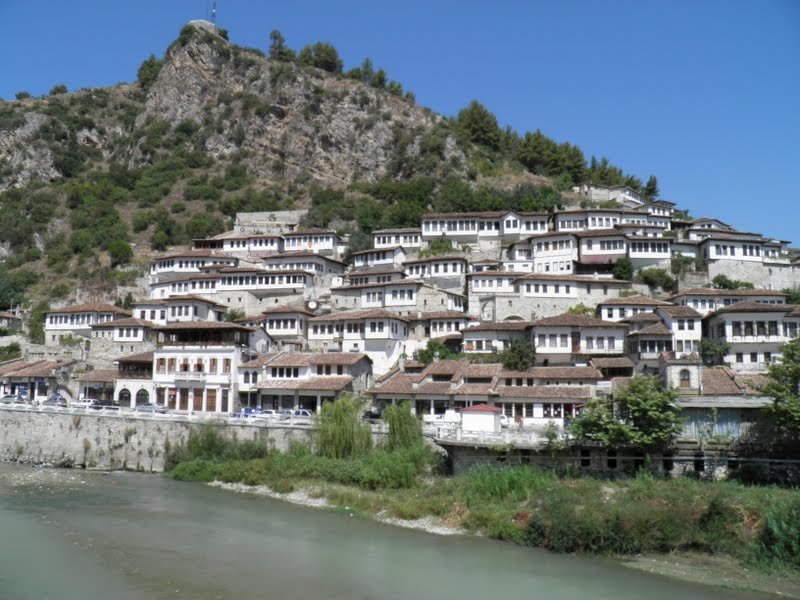
We arrived in Berat at about 3pm.  The town was designated as a 'museum town’ by the communist regime and is therefore one of a very rare breed in Albania that were maintained rather than flattened over the last half century.  The old town is built into a hillside and was developed mainly by the Ottomans with a huge fort on the hill top.  Before I came on this trip I would have no idea how to describe 'Ottoman architecture’, though Berat is definitely a prime example of the simple but extremely attractive and window dominated building style.  The town has gained the nickname 'city of a thousand windows’.  We stayed at the 'Castle Park Hotel’, located about 1.5km out of town in the hillside, surrounded by a forest.  While Ellie was certain that staying at a castle in an Albanian forest would be a bit dodgy, it turned out to be really nice and was full of Italians who use Albania for a cheap holiday.  The view over the new town is stunning, even if the new town itself is pretty ugly, as the area is extremely mountainous.  We still had a nightbus hangover so took it easy at the hotel restaurant for our first day.

Rubbish at the castle
Starting fairly early to avoid the heat (I think I am right in saying that Berat is the furthest south we will be going in the European part of the trip), we walked down into town along a winding mountain road.  We thought it would be wise to go up to the castle first to avoid the heat, but it took us so long to get up that it was about midday when we got in.  The town is one of two Albanian UNESCO World Heritage Sites, but judging by the castle the money has gone towards saving it, rather than promoting it as a tourist attraction.  There is a neighborhood inside the castle where locals live on cobbled streets in pleasant Ottoman style houses, driving battered old Mercedes.   Unfortunately this community isn’t very considerate when it comes to rubbish disposal and it seems that they literally tip their bins over the castle walls - I have never seen such a badly cared for heritage site and it is a real shame.  For the sake of balance I will show you both the good and the bad of the fortress - the views over the surrounding area is stunning, though the ongoing forest fire problem in the country was quite obvious, with lots of smoke coming from wooded areas on the valley sides.  Having spent about two hours in the castle, and with mixed feelings about it, we headed back into the medieval and Ottoman parts of the town.

View from the castle

Berat - the city of a thousand windows
While there are a few museums in the town, we decided to just wander around the old parts, past mosques, old squares and pretty houses.  Unfortunately we had quite a backlog of bookings and reservations to make for the next stage of the trip, so we had to spend a few hours in an internet cafe and by the time we had finished it was time to walk up to the hotel again.  Berat was definitely worth visiting and with more time would be a great base for outdoor activities, but the town needs a lot of work to maintain its architectural assets. 
Share
Tweet
Pin
Share
No comments

The overnight bus (hopefully our last) was probably the worst of the lot.  The battered Macedonian bus had some major faults with it, the worst of which was the fact that the engine growled loudly in the low gears.  The route from Skopje to Tirana is almost entirely through terrifying mountain passes, so it was very rare that we got out of the low gears and therefore we didn’t get much sleep.  The bus arrived in Tirana, the capital, at 4.30 am and we made our way to the hostel in the dark.  What the city is missing in street lighting it makes up in potholes but we luckily made our way to “Freddy’s Hostel” where they let us in to sleep through to midday.

Skanderbeg Square, Tirana
We had only set aside a day in Tirana and by the time that we got going this had shrunk down to half a day.  The  city is dominated by communist concrete architecture but it is interesting to see the historical parts that weren’t flattened, as well as the capital of a nation that has only just opened up to tourists.  We started at Skanderbeg Square, named after the Albanian national hero who fought the Turks.  His name means ‘Lord Alexander’ in Turkish as he named himself after Alexander the Great.  The statue of Skanderbeg was the only thing that hadn’t been removed in the square when we visited as there was major construction work taking place.  One side of the square has some rather attractive Italian style buildings which are used by the government and we had lunch at an Italian restaurant opposite.  The maps show that the city is divided in half by a river, but this is quite an overstatement as the river cannot be more than a metre in width.  On the south bank of the river is 'the pyramid’.  This was supposed to be the mausoleum of Enver Hoxha, the communist dictator, as well as a museum glorifying his life.  Now that the communists are gone it has fallen into a state of disrepair and while Lonely Planet says it is still used for conferences, it seems unlikely from the amount of graffiti and damage on the exterior.

'The Pyramid’, Tirana
The main boulevard through the city passes through Skanderbeg Square, across the river past the pyramid and then to the buildings of the communist government including the current prime minister’s residence and congress building.  Both of these are fairly ugly concrete buildings and the ugliest of all surround Mother Theresa square in the south of the city - a memorial that pales in comparison with the one in Skopje.  On our way back to the river we passed one of the most visible remainders of the communist regime - the Hoxha Bunkers.  After the relationship between Albania and the USSR, particularly after the 1968 invasion of Czechoslovakia, Enver Hoxha decided to construct an enormous array of bunker pillboxes.  As many as 700,000 were built at twice the cost and using three times the concrete as the French Maginot Line.  The engineer who designed them was asked by Hoxha to prove their strength by standing in one while it was fired at by a tank and the remarkable strength of the bunkers has proved to be a huge problem in modern day Albania.  Weighing in at around 5 tonnes each and located in parks, squares, beaches, gardens and pretty much everywhere else, it would require an enormous amount of time and effort to remove them.  As a result they have just been left, though there are stories of people spending months taking them apart with sledgehammers in their gardens.  The one that we saw was opposite the prime minister’s residence and had only been partially destroyed.

The remains of a Hoxha Bunker, central Tirana

Ellie inside Ethem Bey Mosque
After seeing the bunker we headed to the Blloku district, an area where only the main players in the communist party were allowed to visit.  The opulence of the buildings and houses, particularly that of Hoxha himself, shows just who the winners were from Albanian communism.  Unfortunately the only areas of the city that weren’t flattened are those that the party deemed to be of 'national cultural importance’, so on our way back to the hotel we stopped off at the Ethem Bey Mosque.  The mosque is pretty tiny as they go, but has an amazing painted roof and as it is positioned on Skanderbeg Square, it is a pleasant break from the larger government buildings.  The last remnants of pre-communist Tirana that we were able to see were the old clocktower, an old Ottoman bridge and the pretty dilapidated remains of a roman era fortress.  The locals haven’t let their city be totally ruined by communist architecture though, if that is the feeling that comes across from reading this blog.  They have done what they can, by painting the drab grey concrete in a real array of colours so that while the architecture itself is pretty dire, the city does actually have quite a lively and vibrant feel.  It was definitely worth visiting for a day on our way to the more scenic parts of Albania.

Brightening the mood

Share
Tweet
Pin
Share
No comments
“Skopje reveals a difference between the Slav and the Turk, the European and the Asiatic, at every turn of the street”

The train left from Bitola at 12.40 for Skopje.  We decided to use the train instead of a bus as we thought it would be more comfortable, despite taking double the time and it cost half the price at 210 MKD (about 3 GBP).  Unfortunately the train wasn’t quite as comfortable as we expected as it was an ancient carriage and we ended up with a family of seven squeezing into the compartment with us - meaning that there were nine people in a space that should have fitted six.  The train was on time but when we arrived in Skopje we were too tired to do anything so went to a pizza restaurant.

Alexander the Great statue
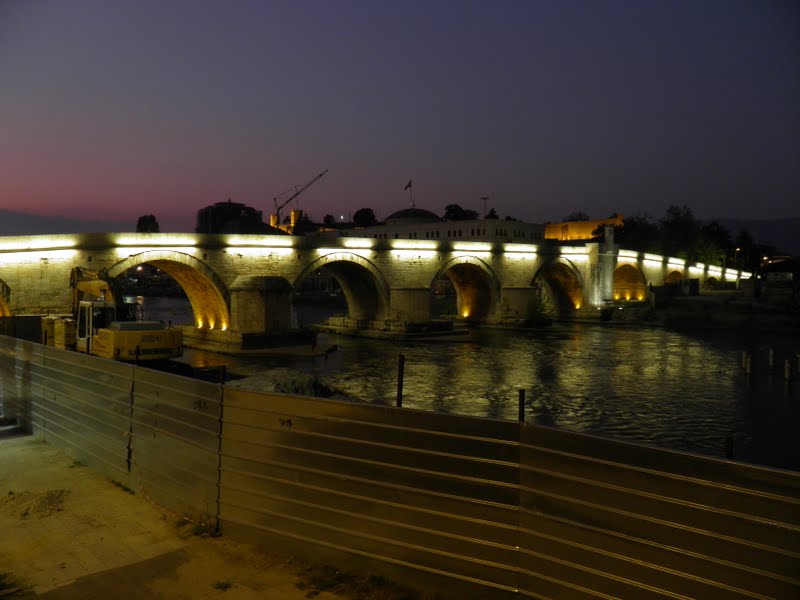
The next day we decided to try and see everything.  The city definitely doesn’t have anything like the natural beauty of Ohrid or the culture of Bitola, but as the capital is an unavoidable place to visit.  We started late, having lunch at …McDonalds… and briefly looked around the south bank of the river Vardar which contains mainly by office buildings and shops.  It also has the main square, Plostad Makedonija, with an enormous statue of Alexander the Great in the centre. The statue is the only thing that seems to be finished in an area of about a square mile of building work.  They are obviously renovating the entire city centre which means that you can see that it will be impressive in a few years time, but at the moment it is just dusty and messy.  Having decided that the south bank wasn’t doing much for us, we moved to the north bank across the pretty Ottoman bridge.  The north bank is far more impressive as it is based around the Carsija where Skopje’s Ottoman past is based.

The Kale Fortress, Skopje
Where the south bank is very concrete based, the north bank is made up of small Ottoman style buildings which are used as shops and cafes.  On the hill above the city is the Kale, the Ottoman fortress which looks a lot like the one at Ohrid.  We wandered through the Carsija to see the Mustafa Pasa mosque which we couldn’t go inside as afternoon prayers had just started.  The plan was then to go inside the Kale fortress but when we climbed up to the top we found that it seemed to be closed.  Later, when we spoke to the owner of the hostel about the closure, we were told that it had been shut to the public for the last 2 months.  The reason, he said, was that there is currently a conflict between the Albanian and Macedonian population of the city over a church.  It was difficult to gather the details, but it seemed that  an argument had begun over whether a church should be built in the fortress compound or whether it should be classified as a museum.  The argument had escalated into full blown fights, where local Albanians and Macedonians would speak to each other on facebook and arrange to meet each other and beat each other up in the castle grounds.  The police decided it was best to shut it all down.  This was a bit of a shame, because the view over the city and surrounding mountains would have been really good.

Sveti Spas church and Gorce Delcev’s tomb
Walking back down from the castle we visited the Sveti Spas church.  This was built during Ottoman rule where the law stated that churches could never be taller than mosques.  As a result, the church was sunk into the ground so doesn’t look particularly impressive from the outside but contains an enormous carved wooden iconostasis.  It is now a museum and the entrance fee of 120 MKD also entitled us to visit a museum about Gorce Delcev, a Macedonian leader of the VMRO and national leader killed by Turks in 1903.  His tomb lies in the church’s courtyard. According to Lonely Planet this was the last major sight in the city, but on our way back on the south bank we came across a new attraction which is perhaps the most important that the city has to offer.  Though few people know it, Mother Theresa is an ethnic Albanian who was born in Skopje.  The house where she was born is long gone, but a museum and church has been built on the site of a previous church where she was baptised.  The museum is really well done and contains a few of Mother Theresa’s more recognizable possessions - her blue and white sari and her rosary beads.  A church has been built on the top level of the three storey building.  The city is full of beggar children who work in small groups and as we left the Mother Theresa memorial building a group approached us, only for them to be shooed away by the building’s security guards - which didn’t seem quite in the spirit of the place.

Mother Theresa memorial building, Skopje

The Ottoman Bridge, Skopje
That night we went out for dinner on the north bank at a traditional kebab house where a filling meal costs less than a fiver.  On our way to the restaurant we passed an enormous festival where we were able to see the legendary Spinning Dervishes - while they tend to be thought of as Turkish, the dervishes can be found all over the former Ottoman Empire and having missed them in Turkey it was fantastic to be able to see them.  The two banks of the river provided quite a contrast - on the south bank were noisy bars and clubs, dominated by young Macedonians, while the north bank was filled with Albanian families at the festival.  The next day we decided to have a day off sight seeing and went shopping in downtown Skopje, before catching the overnight bus to Tirana in Albania at 7pm.


Share
Tweet
Pin
Share
No comments
“Bitola should have a future as a tourist centre, for when the acacias are out it is a fantastically lovely city”

St  Sofia Church, Ohrid
There was still one more sight that we wanted to see at Ohrid before we departed, the church of St Sofia in the town centre.  This is the largest church in Ohrid and is based on its namesake in Istanbul (though quite how I don’t understand).  It spent 500 years as a mosque when Macedonia was part of the Ottoman Empire and unfortunately its charms were lost on us when an army of shutterbugs arrived. We got a taxi to the bus station (cosing about 80p for a 10 minute journey) and then took the bus on the hour and a quarter journey to Bitola.  The journey passed through terrain straight out of the Italian job and the abandoned smashed up buses by the roadside, surrounded by crosses and flowers didn’t help me to put the film’s final scene out of my mind (nor did the fact that halfway through the journey we stopped at a chapel where everybody filled up their bottles with holy water).  With the odds seemingly against it however, we did arrive in Bitola both on time and alive.

Mosaics at Heraklea
Bitola is one of those ‘faded grandeur’ cities that I have often come across in former Yugoslavia.  At one stage it was the second biggest city in Ottoman Europe and was a centre of trade and politics - it was nicknamed the 'city of consuls’ as all the major European powers had embassies here.  The embassies remain, but the grand buildings they once occupied here now have been generally sold off, leaving diplomats with a fraction of the former space.  We were staying at the beautiful Chora Guesthouse on the edge of town, built into a traditional Ottoman house.  There isn’t loads to see in the town itself, but a kilometer out of the centre one of the ruins of the Roman city of Heraklea.  The ruins are compact and the theatre is mainly reconstructed, but the mosaics that are preserved are probably the best I have ever come across.  The entrance fee was a modest 100 MKD each, but they wanted a massive 300 MKD from anybody who wanted to take photos.  Luckily the guy on the gate was pretty relaxed and let us both in for 50 MKD as students and turned a blind eye to our cameras.  The whole atmosphere at the ruins was very relaxed and they didn’t seem to mind people walking all over the walls and other remains.

Sveti Dimitrija Church, Bitola
It was about 4pm by the time that we got back to town but this left enough time to wander around the pretty pedestrianised shopping streets and to look at the churches, mosques and old clock tower that are the main sights. We decided to go into one of the churches - the church of Sveti Dimitrija, which we were shown around by a little old lady.  She asked us if we were Catholics, which Ellie could answer fairly easily but which I had to answer with 'church of England’. She had understandably never heard of this so, deciding that the story of Henry VIII and his wives would probably cause a fair bit of shock, I settled for calling myself a Protestant. She nodded to confirm that she had heard of this religion, but then checked that I knew who Jesus and Mary were.  We lit a candle at the pretty church as the lady had given us quite an insight into the faith.

Russian Embassy, Bitola
It was now getting towards dinner time and we decided to have a meal at a restaurant in the Russian Embassy building (where the current embassy occupies the top floor).  The meal was good but we regretted asking for Turkish coffee at the end as they served it in a normal sized mug rather than the little 'shot’ that it should come in. For those of you who have never hard Turkish coffee, this is the equivalent of being served whiskey in a pint glass, so we left the restaurant with quite a buzz. On the way back we stopped at a little supermarket, which is worth mentioning as a sight in itself.  I have never seen such chaos - it wasn’t even as though they had just forgotten to tidy it in a while, it was more like the delivery man had launched the stock at them with a cannon.  It was near impossible to walk, but the kindly owner (who glided around as if it was wide-aisled Waitrose) gave us some information about the train we were planning to catch to Skopje in the morning.
Share
Tweet
Pin
Share
No comments
Newer Posts
Older Posts

Search This Blog

About me

About Me


Aenean sollicitudin, lorem quis bibendum auctor, nisi elit consequat ipsum, nec sagittis sem nibh id elit. Duis sed odio sit amet nibh vulputate.

recent posts

Follow Us

Blog Archive

  • ▼  2017 (7)
    • ▼  October (7)
      • South Africa’s 44 blue flag beaches for 2017
      • Europe’s most glam holiday destinations is French ...
      • Alcohol helps you speak foreign languages better, ...
      • Government to cut pilot evaluators for large airli...
      • Nepal POKHARA Day#3
      • Nepal RAMKOT Travel Adventure - Day #2
      • Nepal Bandipur Travel Adventure - Day #1
  • ►  2014 (76)
    • ►  November (8)
    • ►  August (6)
    • ►  July (5)
    • ►  June (10)
    • ►  May (15)
    • ►  April (1)
    • ►  March (4)
    • ►  February (10)
    • ►  January (17)
  • ►  2013 (12)
    • ►  December (1)
    • ►  November (6)
    • ►  September (4)
    • ►  August (1)
  • ►  2012 (27)
    • ►  September (10)
    • ►  August (15)
    • ►  July (1)
    • ►  May (1)
  • ►  2011 (73)
    • ►  September (8)
    • ►  August (15)
    • ►  July (3)
    • ►  June (11)
    • ►  May (24)
    • ►  April (3)
    • ►  March (3)
    • ►  January (6)
  • ►  2010 (27)
    • ►  November (11)
    • ►  September (9)
    • ►  August (7)
  • ►  2009 (14)
    • ►  August (8)
    • ►  July (5)
    • ►  June (1)

Labels

10000 Camellia Blossom Temple airlines Albania Amedi Amediyah Anzac Anzac Cove Aphrodisias Assos Austrian Airlines Erbil Ayvalik Backpacking Iraq Backpacking Kurdistan Baisha Bandipur Basilica Cisterns Behramkale Bekhal Waterfall Berat Bergama Beyoglu Bitola Blue Flag Beaches Blue Mosque Bosnia Hercegovina Budva canada Cappadocia Cerro Ena China Corcovado National Park Costa Rica Crowded House Hostel Dali Dohuk Dohuk Dam Donald Duoyishu Eceabat Education England Ephesus Erbil Erhai Lake Family Mall Erbil Freddy's Hostel French Concession FYROM Galata Tower Gali Ali Beg Waterfall Gallipoli Gloucestershire Goreme Hagia Sophia Halfway Guesthouse Hamilton Road Heraklea Hierapolis Hitchin Boys School Hostel Pangea Hotel Qandeel Huangpu River Cruise Iraq Iraqi Kurdistan Istanbul Jade Dragon Snow Mountain Jajce Jianshui Karst Landscape Kotor Kunming La Fortuna La Gran Vista Lake Ohrid Lalish Temple Lijiang Limestone Lone Pine Cemetary Luijazui Macedonia Montenegro Monteverde Mostar Napal news Osa Peninsular Pacuare Pamukkale Pergamum Pigeon Valley Pliva Lakes Pokhra Port Jim Puerto Jimenez Qing Architecture Ramkot Rawanduz Gorge Red Basilica Red Valley regular Roman Rose Valley Rozafa Fortress San Jose Selcuk Shanghai Shanghai Museum Shilin Shkoder Shkodra Shuhe Skopje South Africa Stone Forest Sulav Suleymaniye Mosque Sveti Stefan Tamarindo The Bund The Confucian Temple Three Pagodas Tiger Leaping Gorge Tirana Topkapi Palace Travel Travel Adventure Travertines Troy Turkey Turtle Sanctuary Twin Dragon Bridge Ulcinj Urban Planning Museum Usichar Volcan Arenal Watermills World Challenge Xinjie Yazidi Yazidians Yuanyang Rice Terraces Yunnan Province

Follow Google +

Unknown
View my complete profile
FOLLOW ME @INSTAGRAM

Created with by BeautyTemplates